
Scientific name: Zea mays subsp. mays
Synonym: Zea mays subsp. indurata
Variety: Glass Gem
Common name: Glass Gem corn
Family: Poaceae
Article by Noah Gapsis, Horticulturalist
Hold an ear of Glass Gem corn up to the light and it stops looking like a vegetable and begins to look more like a work of art. That is not a happy accident. It is the endpoint of thousands of years of deliberate human attention: first, by generations of Indigenous farmers who domesticated maize and bred it to survive harsh growing conditions and later by the patient work of 20th-century seed keepers determined not to let that inheritance disappear.
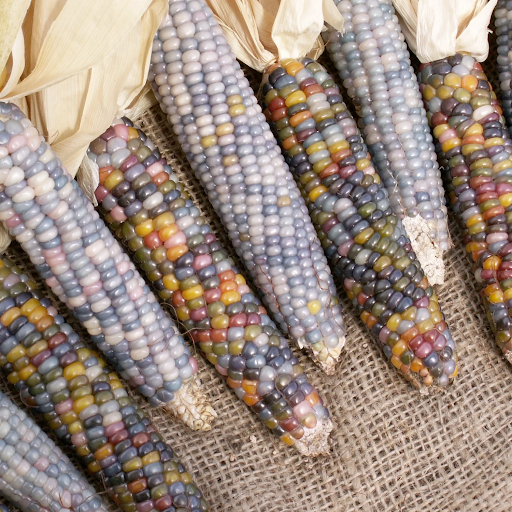
Photo: Glass Gem corn. Native Seeds/SEARCH, https://www.nativeseeds.org/products/zp103?variant=37953899397274. Accessed 21 Aug. 2026.
Modern maize (Zea mays) was domesticated from wild teosinte grass (Zea mays subsp. parviglumis) in the Balsas river basin of southwestern Mexico roughly 9,000 years ago. Over centuries, farmers developed diverse landraces: varieties cultivated in and, over time, adapted to their specific geographic regions. To shape these crops for new environments as they carried them northward, growers relied on deliberate mass selection: the practice of growing a crop, observing which individual plants thrive or show desired traits, and saving seed only from those particular individuals. Because maize plants typically shed pollen from their male tassels before the female silks on the same plant are fully receptive, they are less likely to fertilize themselves. Instead, they rely on the wind to blow pollen from neighboring stalks. This means they naturally cross-pollinate and mix their genetics, rather than breeding true. By intentionally saving seed from standout ears and roguing (the practice of walking the field and “roguing out,” or removing weak and off-type plants before they shed pollen), growers steadily directed this genetic drift toward increased productivity, resilience, and culturally revered colors.
By roughly 2000 BCE (Before Common Era), early maize landraces reached the arid Colorado Plateau, where annual rainfall rarely exceeds 10 to 12 inches (25.4 to 30.48 cm). Hopi and Ancestral Puebloan farmers met these punishing conditions through sophisticated dry-farming techniques, continuously selecting and shaping the traits of the corn over generations to thrive in the desert – an agricultural legacy that remains active today.
Rather than surface sowing, Hopi planters use a so’ya (traditional wooden digging stick) to deposit kernels from 10 up to 18 inches (25.4 to 45.72 cm) deep, placing the seed into residual subsoil moisture below the parched surface. While standard commercial sweet corn varieties fail to germinate and emerge from such depths, southwestern landraces developed a specialized, elongated mesocotyl (the embryonic structure that pushes the shoot up from the seed), allowing the seedling to travel a foot through the soil to reach the surface. Planting is done in clusters of 8 to 12 seeds, which provides shared structural support to break through soil and withstand desert winds. Using a farming strategy regionally referred to as ak-chin, O’odham for “mouth of the wash,” fields are carefully selected across alluvial fans and arroyo mouths to capture sheet flow, silt, and moisture from seasonal summer monsoon runoff. Through centuries of applying these ingenious techniques, farmers successfully nurtured crops that developed deep, vigorous root systems and an extraordinarily diverse genetic reservoir.
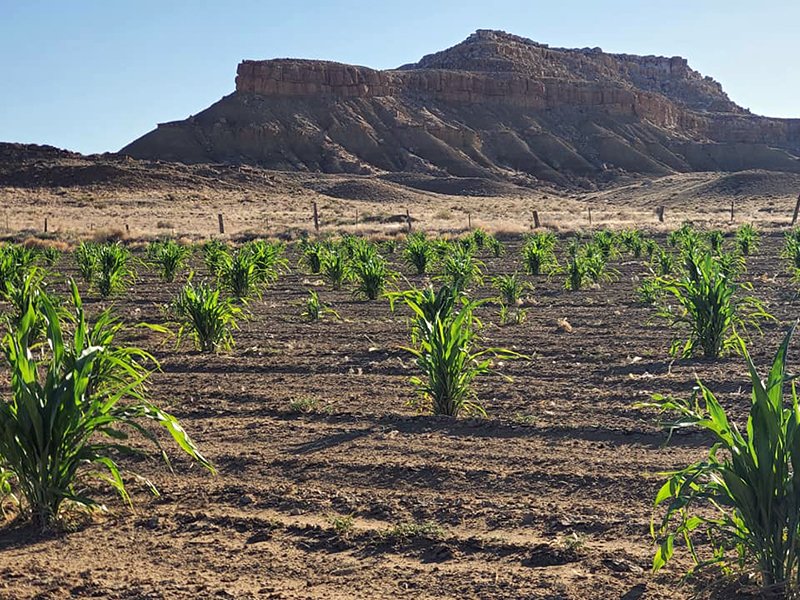
Photo: Kotutwa Johnson, Michael. Hopi dry farming plot. BorderLore, https://borderlore.org/its-gonna-be-okay-faith-and-climate-on-a-hopi-drylands-farm. Accessed 21 Aug. 2026.
These agricultural practices are not just in service of survival; they are the groundwork of a spiritual relationship with the land. Across Southwestern Indigenous traditions, corn has never been treated as a mere commodity crop; it is recognized as a living relative and foundational sustenance. Among Keres-speaking Pueblos (including Acoma and Laguna), perfect ears represent the maternal deity I’yatiku (the Corn Mother), given to newborns as protectors and used throughout ceremonial rites of passage. In Hopi tradition, finely ground hooma (cornmeal) serves as a vital daily offering of gratitude and blessing; distinct pigmented forms, such as Hopi blue corn, fulfill ceremonial and culinary roles. It is nixtamalized with wood ash and used to produce delicate, paper-thin piki bread, a central element in ceremonial and social gatherings. Despite the endurance of these practices, the 20th century saw many of these unique ancestral lineages threatened by displacement and the loss of traditional knowledge, creating an urgent need for dedicated preservation.
In the late 20th century, Carl Barnes (1928–2016), an Oklahoma farmer of Cherokee descent, began collecting isolated ancestral landraces from Cherokee, Osage, Pawnee, and Hopi lineages that were rapidly disappearing. Barnes planted these lines together and let them cross-pollinate in his fields, then practiced recurrent mass selection over decades. He carefully isolated the plots to keep windborne pollen pure, rouged out undesirable plants, and replanted only the ears that exhibited an unusual, glassy translucence and vivid jewel tones. In 1995, Barnes shared his seed lines with Greg Schoen, who grew and refined the strains in places like Santa Clara Pueblo and the Española Valley, before introducing them to Native Seeds/SEARCH in Tucson in 2009. This work stabilized the heirloom strain known worldwide as “Glass Gem.” The name honors its legacy and botanical classification: the former name and current taxonomic synonym, Zea mays var. indurata, from the Latin for “hardened,” also known as flint corn, is characterized by a hard, glassy outer shell, creating the iconic translucent appearance and protecting the soft starchy nourishment inside.
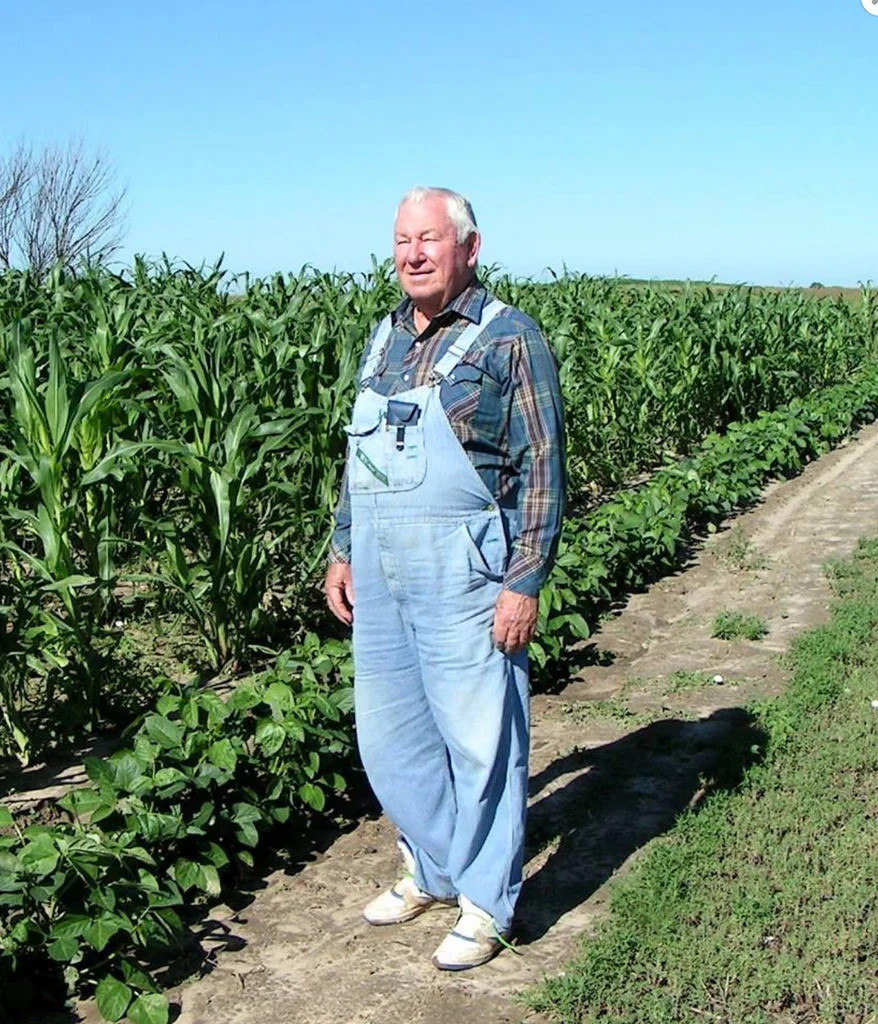
Photo: Carl Barnes. Native Seeds SEARCH. https://www.nativeseeds.org/blogs/blog-news/the-story-of-glass-gem-corn-beauty-history-and-hope. Accessed 21 Aug. 2026.
Barnes returned ancestral seeds to the Indigenous nations whose forebears developed them. This practice aligned closely with the broader seed rematriation movement, which is an Indigenous-led effort to reclaim, preserve, and restore ancestral crop varieties in their original communities. Today, sovereign initiatives like the Cherokee Nation Heirloom Seed Bank, regional non-profits like Native Seeds/SEARCH, and national networks like the Indigenous Seed Keepers Network actively steward and redistribute these landraces, protecting agricultural biodiversity and community food sovereignty.
Today, Glass Gem has found a place on small-scale farms and gardens across New Mexico and the Southwest. While their striking appearance makes them popular for ornamental displays, they are fundamentally functional food crops. Because flint corns possess a hard, dense starch matrix and low sugar content, they are not consumed fresh like sweet corn. Instead, ears are dried directly on the stalk before processing. The dense, moisture-trapping outer hull makes smaller kernels pop reliably, yielding a tender white popcorn with crunchy texture. When ground in a grain mill, the vitreous kernels produce cornmeal with a deep, earthy flavor. Alternatively, the kernels can be nixtamalized: soaked and simmered in an alkaline solution, traditionally culinary wood ash or lime, to dissolve the tough outer pericarp and unlock nutrients. The resulting hominy can be ground into masa for tortillas and tamales. For regional growers in the short seasons of our high altitude steppe, these flint varieties remain exceptionally rewarding. Requiring roughly 100 to 110 days to maturity, their deep-rooted ancestry allows them to thrive in intense sun, alkaline soils, and hot summer days.
This season we ourselves grew Glass Gem in the agricultural terraces at the Botanical Garden, which gave us a firsthand lesson in why corn is universally coveted by pretty much everything in the ecosystem. We planted our seeds roughly two inches deep – admittedly shallow compared to ancient dry-farming techniques – and the local wildlife treated it like an open invitation. The following day after volunteers and I finished planting, crows, somehow spotting the fresh furrows, descended for an easy snack. Some survived and some were reseeded, pushing up strongly, until rabbits and other rodents next discovered them and started nibbling the young greens daily.
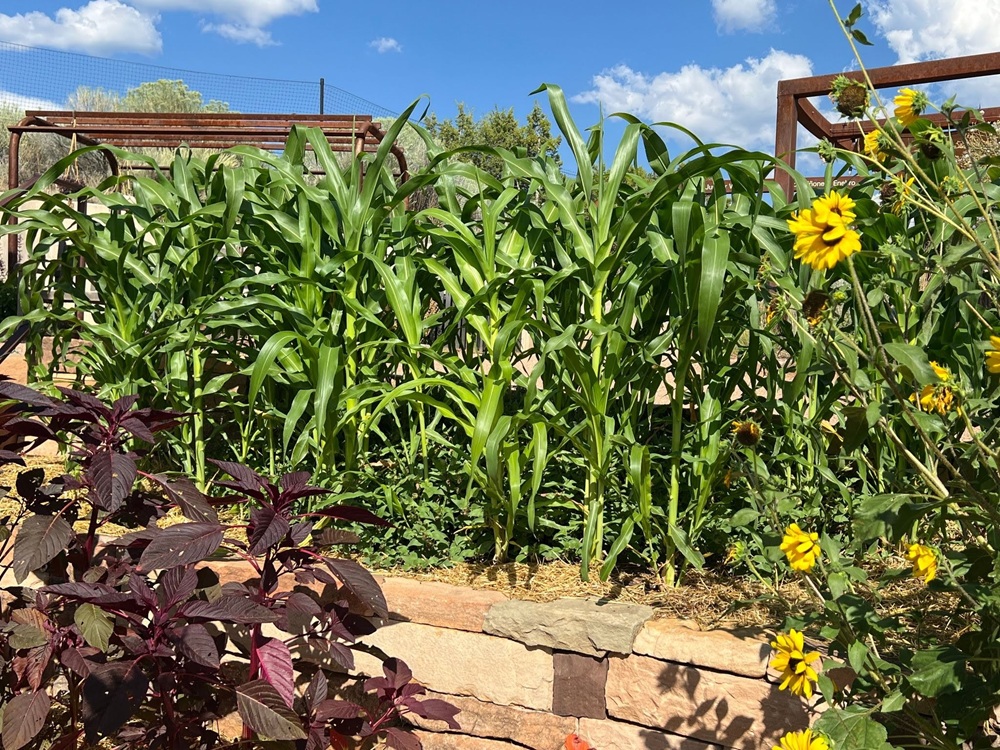
Photo by Noah Gapsis. SFBG terraces.
Unlike traditional dryland farmers who work with lean, harsh conditions, our garden terraces offered rich compost, steady irrigation, and a bit of fertilizer. That luxurious treatment backfired a little by growing ultra-tender, sugar-and-nutrient-packed shoots that local critters flocked to. We ended up having to drape row cover over the patch (and many other crops in the terraces, as well) to protect the plants through their toddler phase until they gained enough height and toughness to fend for themselves in mid-August. We didn’t have a large expanse to plant in blocks, but we tried to plant 2 deep instead of neat single rows to help the wind do its job with pollination; some of that organization was lost to predation too. Dealing with all the feathered and furry residents made one thing clear: corn is packed with life and energy, a prized sustenance not just for humans grinding it into flour, but for all our hungry neighbors sharing the high desert.
Key References & Further Reading
Wall, D., & Masayesva, V. (2004): “People of the Corn: Teachings in Hopi Traditional Agriculture, Spirituality, and Sustainability.” American Indian Quarterly. Freely available at: https://pfp.crowcanyon.org/lessons/Wall2004_People_of_the_Corn.pdf
Johnson, M. K., & Eisele, K. (2020): “‘It’s Gonna Be Okay’ – A Hopi Drylands Farmer on Faith and Climate.” Borderlore. https://borderlore.org/its-gonna-be-okay-faith-and-climate-on-a-hopi-drylands-farm/
Nabhan, G. P. (The University of Arizona): “The ecology of floodwater farming in arid southwestern North America.” University of Arizona Experts Profile. https://experts.arizona.edu/en/persons/gary-p-nabhan/
Schoen, G. (2024): “Glass Gem Corn Origin Stories, Transcribed.” Mama Maize. https://mamamaize.com/blogs/news/glass-gem-corn-origin-stories-transcribed
Native Seeds/SEARCH — Tucson-based non-profit conservation organization that preserves, documents, and distributes arid-land heirloom seeds, including the history of Carl Barnes and Glass Gem introductions. https://www.nativeseeds.org
Indigenous Seed Keepers Network (ISKN) — A national initiative of the Intertribal Agriculture Council supporting community food sovereignty, seed rematriation, and traditional agricultural education. https://indigenousseedkeepers.com