
The Agricultural Terrace Beds within the Ojos y Manos: Eyes and Hands section of the Garden tell a story that’s been unfolding for centuries.
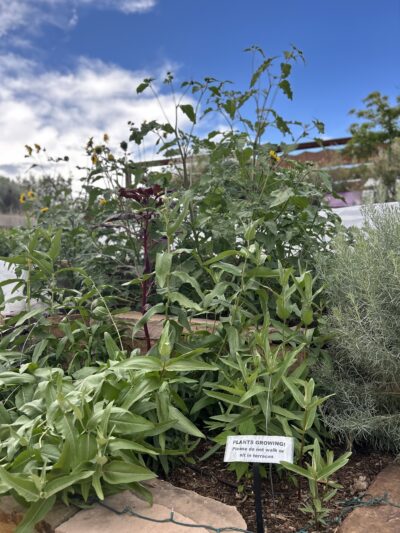
Our agricultural terraces will be in peak season in August and into September
It’s easy to think of history as one clear line, with a single before and after. But agriculture in this region didn’t work that way. It’s a long, continuous story of plants traveling across continents, shaped again and again by the people who grew them. Our terrace beds were designed to show that story.
Before European Contact
The beds representing this earlier era hold wild ancestors of foods we still eat today, growing next to plants that were carefully bred over hundreds of years. Indigenous farmers selected and improved crops for specific purposes: some to survive our dry climate, others to serve a role in ceremony and tradition.
Hopi corn and red amaranth are two good examples. Both were shaped over generations to thrive here and to hold cultural meaning.
After European Contact
The beds representing the period after Spanish contact show a different chapter of the same story. Spanish settlers and missionaries brought plants from far-off places: the Fertile Crescent (the Middle East), sub-Saharan Africa, and Moorish al-Andalus, a region of Spain shaped by centuries of North African and Middle Eastern influence.
These plants didn’t stay the same once they arrived. Growing in New Mexico’s soil and climate changed them all over again.
The Story Went Both Ways
The movement wasn’t only one direction, though.
The chiltepin pepper and the currant tomato both started in the Americas. After contact, they were carried to Europe, where farmers spent centuries selecting and breeding them into something new. Eventually, these transformed plants made their way back to the Americas. Today they look almost nothing like their wild ancestors, which still grow just steps away in these same beds.
A Shared Story of Careful Selection
On both sides of this story, people were doing the same thing: shaping the plants they depended on, generation after generation.
- In Velarde, families saved chile seed for years, until a distinct local variety, called a “landrace,” emerged, one perfectly suited to that specific place.
- In the village of Corrales, growers tended safflower, a dye plant originally from Egypt, until it became something distinctly New Mexican.
Why This Matters
These terrace beds are a living timeline. They show that agriculture here has never stood still. It’s the result of thousands of years of human hands, choices, and care, moving plants across oceans and generations, slowly turning them into the crops we know today.
Next time you pass a pepper plant or a stalk of corn, look closer. You’re looking at centuries of human ingenuity, still growing right in front of you.