
Scientific name: Engelmannia peristenia
Common names: Engelmann’s daisy, cutleaf daisy
Family: Asteraceae
Article and photos by Kevin Archer (except where noted)
Engelmann’s daisy thrives in challenging environments, has a hot-weather strategy, provides many ecosystem services, and is reborn every spring. What could be more inspiring?
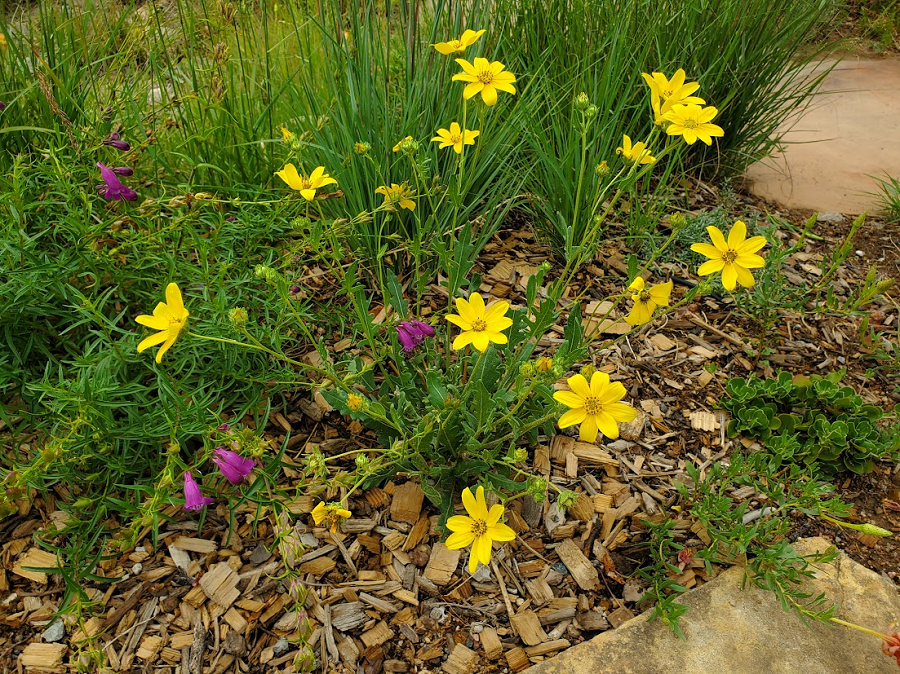
Young Engelmannia peristenia in full bloom (with penstemon). Photo by Linda Churchill.
Also known as the cutleaf daisy, its scientific name honors German-American physician and botanist George Engelmann, who first described this plant in the mid-1800s. Quite prolific, he documented over one hundred cactus species, as well as conifers, yucca, and parasitic plants across western North America and into Mexico. Engelmannia is a somewhat unique genus, in that it contains this lone species.
The composite flowers of E. peristenia sit atop sparsely branched stems reaching up to three feet in height. (The newly planted one in the photo comes up to my knee.) Basal leaves, deeply pinnate, range from six to twelve inches long. Cauline leaves (those on the stem), alternate and round-toothed, may be up to six inches long, low on the stem. They get smaller and sparser as they near the flower heads. Stems and leaves are covered in coarse hair.
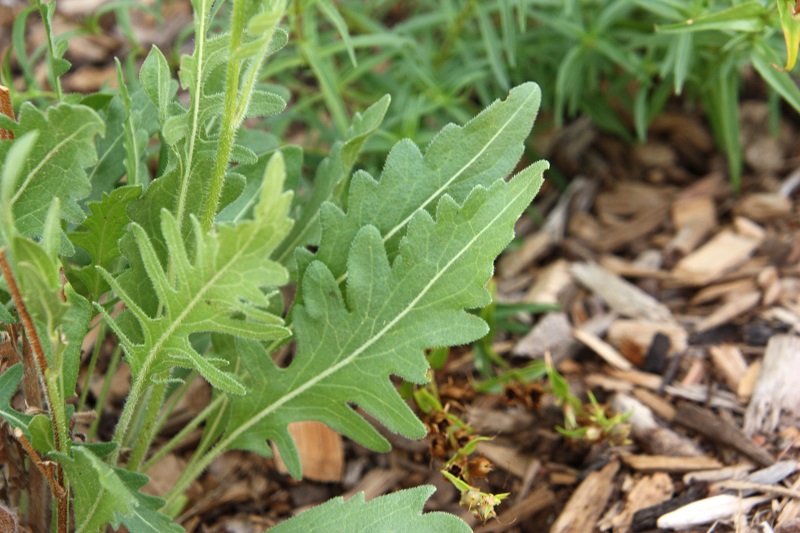
This plant’s alternate common name–cutleaf daisy–is derived from
its pinnatifid leaves. Photo by Kevin Archer.
The flower heads, consisting of eight to ten ray flowers encircling an array of disk flowers, are typically 1-1/2-inches across. The ray flowers, about 1/2-inch long, are female and produce fruit. The disk holds an array of tightly packed perfect flowers and serves as the insect commissary. During the heat of the day, the ray flowers curl under—the flower heads on an individual plant reacting independently of one another.
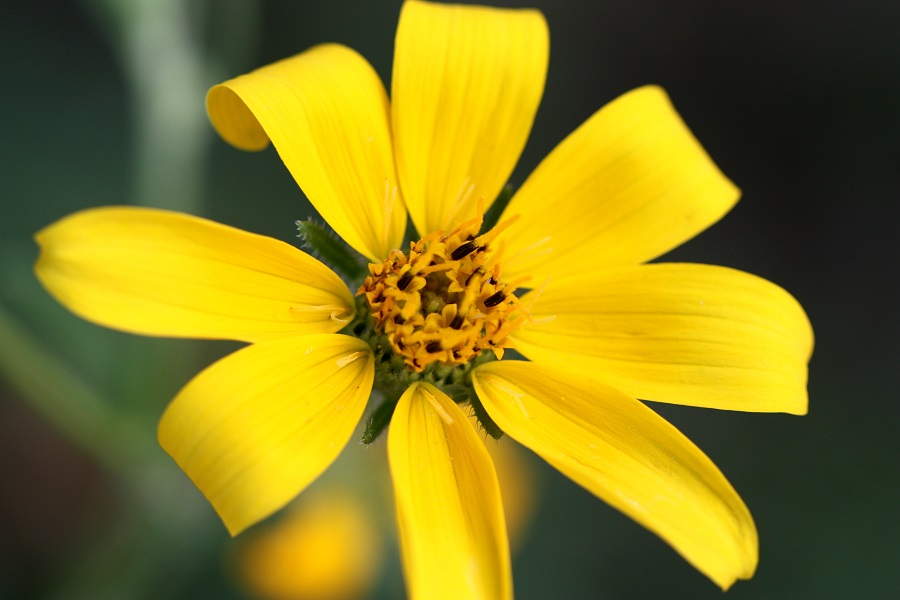
The composite flower head of E. peristenia. Note the pistils on each ray flower, as well as the raised anthers on the disk array. Photo by Kevin Archer.
Engelmann’s daisy generally blooms from June to September, but can last into November in some regions. It reblooms quickly after cutting—or munching, which we’ll get to in a moment. It persists through the winter as an evergreen rosette, sending up new stalks in March.
Its native range reaches from Arizona to Missouri, and from Kansas down into northeastern Mexico. It is often seen beautifying roadsides, brightening piñon-juniper woodlands, and dappling native grasslands and desert scrub alike. It thrives at altitudes up to 7000 feet. It is not considered at risk of extinction, sitting comfortably at an International Union for Conservation of Nature (IUCN) status of Least Concern.
Generally unfussy, E. peristenia can grow in poor or marginalized soils, from sand to loam, clay, and caliche. Its long taproot makes it rather drought-tolerant and ideal for a low-water garden, although it does best with regular water the first year after planting. It is also a good choice for erosion control on a slope or berm.
Engelmann’s daisy produces nectar that is enjoyed by hummingbirds, bees, and butterflies. The flower itself is enjoyed by both domesticated and wild grazers, with Finley & Nieland stating that it is “like ice cream for deer.” Luckily for them, it offers an early spring protein content of up to twenty-five percent. Rabbits are also fond of the leaves.
Much like its kin the sunflower, it produces an achene (a small, dry one-seeded fruit) that is harvested by birds. This small achene “resembles the convoluted cortical folds of the brain.” Additionally, with its dense lower foliation, E. peristenia provides nesting and hiding opportunities for small mammals and birds.
Engelmann’s daisy can enhance any landscape from grasslands to your own garden. Use it “in the perennial border, as a specimen plant, or in the xeriscape garden. It mixes well in wildflower plantings.” Garden and environmental writer Stevie Daniels reports that this indomitable plant can hold its own against prairie grasses, providing opportunities for diverse wild lawns.
Choose a spot with part to full sun in well-drained soil. Seed can be sown in the fall or started in seeding trays and transplanted into the garden in spring. The rosette is best transplanted in the winter.
While beautifying your garden, it is a low maintenance plant. Though rather tall, its stems are sturdy and don’t require any staking. If included in a native meadow garden, it can be mown as long as the blade is set higher than the rosette.
At Santa Fe Botanical Garden, you will find it in the Roland Meadow Garden, waving to you just inches off the path. The photo below shows its exact location.
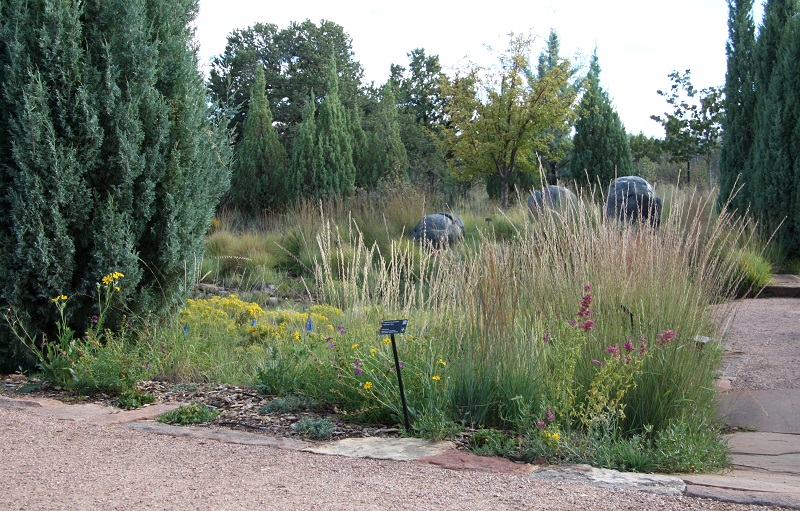
The sign marks the middle of a run of Engelmann’s daisy, just a
few paces from the welcome kiosk. Photo by Kevin Archer.
On a personal note, E. peristenia has increased my plant knowledge considerably. I formerly operated a small organic produce farm with developed pollinator habitat. I know food plants well, and native forbs and grasses on a large scale. Pointing my macro lens at this one plant, so to speak, has been fascinating.
Additionally, this intrepid daisy led me into the Garden’s extensive library. Want to read up on a native plant you’ve seen in the garden? Enjoy a wide-screen view of the flora of the Sangre de Cristo range? Or perhaps you want to develop your own low-water meadow to beautify your home? The Garden’s library covers all that and more, with volumes full of stunning photographs, botanical drawings, and horticultural information. Visit the Garden’s website to learn more and to schedule a visit. Browse through the collection at https://www.librarycat.org/lib/SFBG
Sources
Carr, C. 2010. Plant Guide for Engelmann’s Daisy (Engelmannia peristenia). USDA-Natural Resources Conservation Service, James E. “Bud” Smith Plant Materials Center. Knox City, TX 79529.
Daniels, Stevie. The Wild Lawn Handbook: Alternatives to the Traditional Front Lawn. MacMillan USA, 1995.
Finley, Willa and LaShara J. Nieland. Land of Enchantment Wildflowers: A Guide to the Plants of New Mexico. Texas Tech University Press, 2013.
Heil, Kenneth D., Steve L. O’Kane Jr., Linda M. Reeves, and Arnold Clifford. Flora of the Four Corners Region: Vascular Plants of the San Juan River Drainage, Arizona, Colorado, New Mexico, and Utah. Missouri Botanical Garden, 2013.
Ivey, Robert DeWitt. Flowering Plants of New Mexico. RD Ivey, 1986.
Kirkpatrick, Zoe Merriman. Wildflowers of the Western Plains: A Field Guide. University of Texas Press, 1992.
Littlefield, Larry J. Wildflowers of the Northern and Central Mountains of New Mexico: Sangre de Cristo, Jemez, Sandia, and Manzano. University of New Mexico Press, 2015.
Martin, William C. Summer Flowers of New Mexico. University of New Mexico Press, 1986.
Plant Select. Pretty Tough Plants: 135 Resilient, Water- Smart Choices for a Beautiful Garden. Timber Press, 2017.
Wasowski, Sally, and Andy Wasowski. Native Texas Plants: Landscaping Region by Region. Gulf Publishing Co., 1991.