
Cochineal Scale Bug (Dactylopius coccus)
Blog by Rosy Link, Program Coordinator
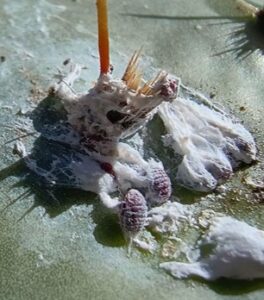
Cochineal bugs near spines on prickly pear cactus.
Alongside the sidewalks and yards of Santa Fe you have probably noticed the iconic prickly pear cactus, Opunia spp. Look closely and you may see a fluffy white substance coating the pads. This is the waxy secretion of a small parasitic insect with a brilliant secret. Hidden underneath the white fluff are small eggs and insects of the Dactylopiidae genus also known as the cochineal scale bug. They are related to other true bugs in the order Hemiptera, including cicadas, aphids, and leafhoppers.
Being careful of the spines, if you were to touch the waxy substance you would be surprised by a vivid red liquid known as carminic acid, a well known colorant used for thousands of years and still used today. Sometimes listed as carmine, Red 4, Crimson Lake, cochineal extract or natural flavorings, this bright red dye is used to color cosmetics, foods, paints and fabrics. All species and stages of the insect including the eggs are reddish in color and produce large amounts (about 24% of dry weight) of carminic acid.
Life cycle:
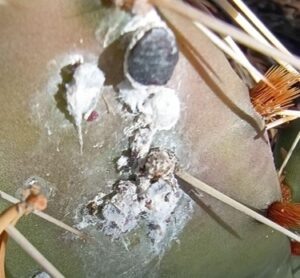
Cochineal bugs aggregated near spines on prickly pear cactus.
Typically, there are about twice as many females as males, so one male usually mates with multiple females. Eggs are laid on the surface of the pads and hatch quickly into nymphs called crawlers. Female crawlers move towards the spines of the cactus, and settle into a spot where they will spend the rest of their lives, completely losing their legs when they molt. Usually, you can see them on the underside and top edge of pads. Placing themselves in these spots helps them to avoid the sun, protects them from predators and enables them to move by wind dispersal. Both females and males have long “fishingline” like strands called filaments that produce the white waxy substance which helps in being carried away to a new location by the wind or hide them from predators.
Males stay near to the mother and eventually form a cocoon where they continue to grow before emerging as adults with long white wings that they don’t tend to use, preferring to crawl in search of females. From egg to adulthood, females can live around 40-180 days, while males typically live for only 35-52 days, depending on the conditions and season.
Ecology:
What is their effect on the cactus plants? In their native range, they tend to be kept in check by predators who don’t mind the carminic acid, including beetles, flies, parasitic wasps and lacewings. In a cool ecological twist, some of these predators (certain beetles and flies) hide away and repurpose the carminic acid for their own protection by excreting it out of various openings when disturbed. In areas where cochineal bugs are introduced, they can be a pest on prickly pear and can be managed with physical removal.
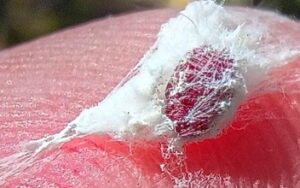
Individual adult female with waxy excretion
Dye Production:
Making dye from the insect is labor intensive. First, cochineal bugs are added to new prickly pear pads, either by transferring the bugs directly or putting new pads into contact with an already infested pad. Then the bugs are allowed to grow and reproduce and are eventually harvested by scraping them off the pads. The insects are killed and dried out, then ground into a fine powder and processed to better extract the color. It takes about 70,000 insects to make about 450g or 1 lb of dye.
History of use by humans:
Cochineal dye has been used for thousands of years, particularly in Mesoamerica and South America. Evidence of cochineal-dyed textiles has been found in ancient Peruvian burials dating back to at least 600 CE. The Aztecs and other Indigenous peoples cultivated cochineal bugs for their brilliant red pigment. By the 10th century, cochineal was being domesticated and traded as a valuable commodity. The Aztecs even required large quantities of cochineal as tribute from conquered communities.
Today, although synthetic dyes have largely replaced natural dyes, cochineal is still produced commercially in countries including Peru, China, Mexico, and Spain. Modern research focuses on improving production efficiency and understanding which insects produce the highest-quality pigment. Researchers have found that pigment levels vary depending on the insect’s age, reproductive status, and geographic origin. These differences affect the color quality and market value of the dye. Cochineal remains an important example of how a tiny insect can have an enormous influence on history, international trade, culture, and agriculture.
Sources:
Timothy D Schowalter, Ecology, use, and management of cochineal insects (Hemiptera: Dactylopiidae), Journal of Integrated Pest Management, Volume 16, Issue 1, 2025, pmaf033, https://doi.org/10.1093/jipm/pmaf033
https://www.monaconatureencyclopedia.com/dactylopius-coccus/?lang=en