
Genus name: Townsendia
Common name: Townsend’s daisy
Family: Asteraceae
Article and photos by Linda Churchill
I’ve been enchanted by a special little wildflower in the aster family for many years. My husband and dog-walking partner might say I’m obsessed, since I spend much of the summer searching for it on neighborhood walks. I usually notice the white or pale lavender blooms of this tiny but mighty beauty in mid-summer, although various sources list it as flowering from spring into early fall. This year I spotted the first blossoms in mid-May, much earlier than is typical in the hills outside Tesuque. Perhaps our extra-mild winter had something to do with it.
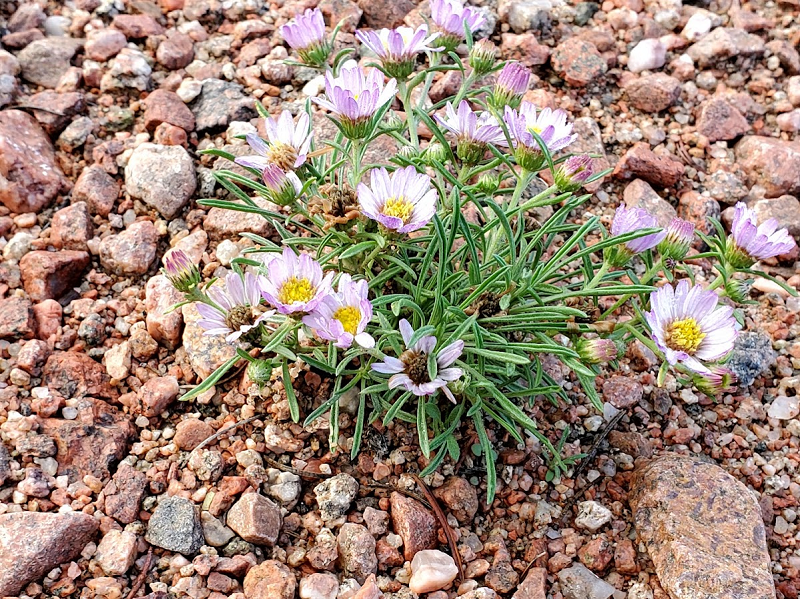
The plant in question is Townsendia fendleri, named for Augustus Fendler, an amateur botanical collector who explored the Southwest and the Santa Fe area in the mid-1800s. (Fendlera rupicola, Penstemon fendleri, Thalictrum fendleri—you get the picture.) I often find this delicate species growing in surprisingly challenging locations: on a raised gravel island in an arroyo, halfway up the side of a barranca, or even tucked in the shade of a mountain mahogany.
Like most members of Asteraceae, Townsendias have both ray and disc flowers that together form the familiar daisy-like head. Out of bloom, they can be easy to overlook. My local T. fendleri plants are only about three inches tall and five or six inches wide. Yet their flowers can be remarkably large in proportion to the plant itself.
We planted several Townsendia parryi seedlings in the Garden in 2025, and by spring 2026 the tiny plants—barely an inch tall and an inch and a half across—produced bright lavender flowers two inches wide, completely hiding the foliage beneath.
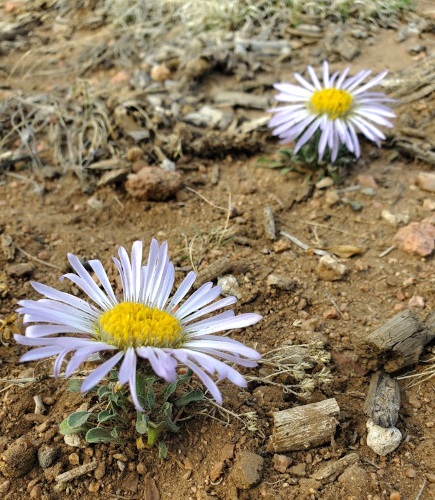
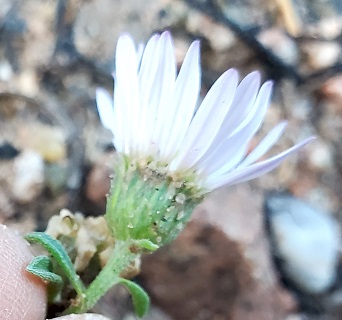
Identifying a plant as a Townsendia can be challenging. Their flowers range from white to pink, lavender, and blue, much like their botanical cousins in the genus Erigeron, and they often grow in similar habitats. A couple of features can help distinguish them. First, many Townsendia species hug the ground, with flowers appearing to arise directly from a central cluster of leaves without an obvious stem. Second, if the flower has gone to seed, examine the pappus (the structure that replaces the sepals in members of the aster family). In Townsendia, these structures are relatively stiff and scale-like, whereas Erigeron species produce soft, dandelion-like tufts.
Even after you’ve determined a plant belongs to the genus Townsendia, identifying the exact species can be yet another challenge. As Intermountain Flora puts it, the genus is “notoriously difficult.” Species are distinguished by subtle differences in features such as the pappus and the shape of the phyllaries (small leaf-like or scale-like bracts that form a cup beneath flower heads in the Asteraceae). To make matters even more interesting, some species reproduce both sexually and apomictically (asexually), adding another layer of complexity for wildflower-loving amateur botanists.
The genus includes annuals, biennials, and perennials. About 10–12 species are native to New Mexico, and roughly 25 species occur across western North America. The genus name honors David Townsend, a banker and amateur botanist who, unlike Mr. Fendler, probably never visited the American Southwest, the native home of most Townsendia species.
Some thrive high in the Colorado mountains, while others are native to the Texas Panhandle. Many make excellent additions to dry gardens and rock gardens. Fortunately for Santa Fe gardeners, several species are perfectly at home in piñon-juniper woodlands. Most are readily grown from seed using standard native seed propagation techniques.
One species we have observed several times at the Santa Fe Botanical Garden, though not every year, is Townsendia exscapa, commonly known as Easter daisy.
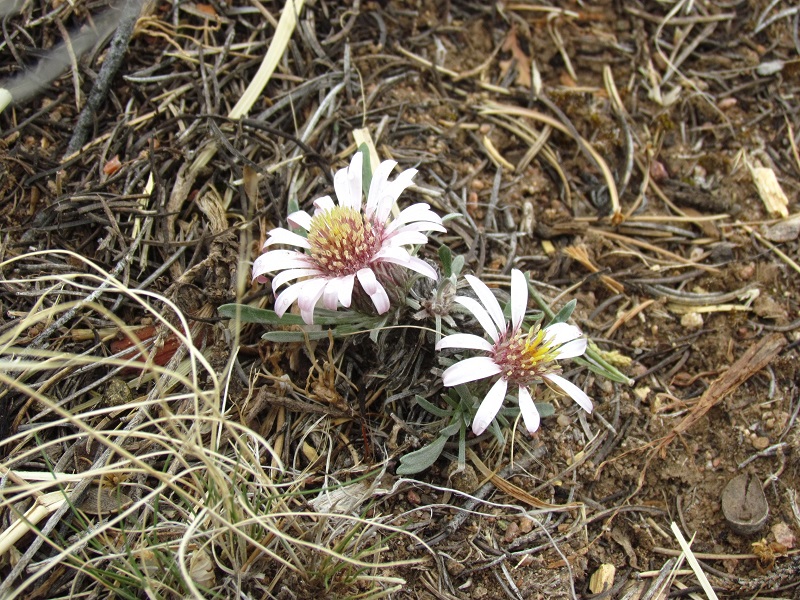
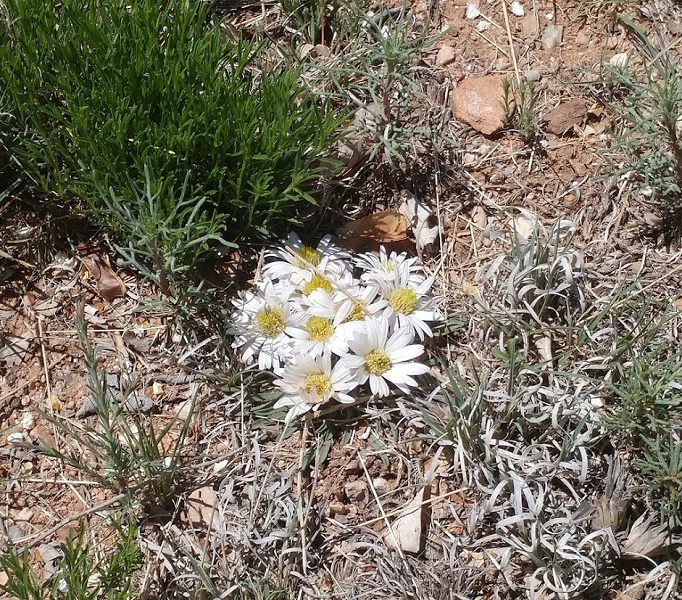
This delightful little character, named for its presumed bloom time, produces white flowers up to two and a half inches across that nearly conceal the plant itself. As with T. parryi, you have to look carefully for the small plant, with its lovely stemless flowers emerging directly from the gravelly soil. Although Easter daisy is said to bloom early in spring, we most often encounter it in May or June.
And finally, back to the species that started my fascination. T. fendleri is native only to parts of southern Colorado and a handful of counties in northern New Mexico. Because of this limited distribution, it is considered a species of conservation concern. I feel fortunate to encounter it every summer in my Tesuque foothills neighborhood—and I suspect I’ll continue searching for those delicate blooms on my walks for many years to come.
References
Denver Botanic Gardens. Wildflowers of the Rocky Mountain Region. Timber Press, 2009.
Heil, Kenneth D., Steve L. O’Kane Jr., Linda M. Reeves, and Arnold Clifford. Flora of the Four Corners Region: Vascular Plants of the San Juan River Drainage, Arizona, Colorado, New Mexico, and Utah. Missouri Botanical Garden Press, 2013.
Nold, Robert. High and Dry: Gardening with Cold-Hardy Dryland Plants. Timber Press, 2008.
“David Townsend.” Wikipedia, Wikimedia Foundation, en.wikipedia.org/wiki/David_Townsend_(botanist). Accessed 18 June 2026.
“Townsendia incana.” Southwest Colorado Wildflowers, www.swcoloradowildflowers.com/Slide%20Shows/Semi-desert%20Wildflowers%20of%20Canyons%20of%20the%20Ancients%20National%20Monument/pages/Townsendia%20incana.htm. Accessed 18 June 2026.
“Townsendia incana.” SEINet Southwest Biodiversity Portal, https://swbiodiversity.org/seinet/taxa/index.php?tid=4310&clid=3196&pid=&taxauthid=1. Accessed 18 June 2026.