
House Centipedes: Speedy Garden Friends

Photo by Ray Lemke
Blog by Rosy Link, Garden Educator
Out of the corner of my eye a small dark blob rushed past the door. My cats and I looked intently after it and began a race to see who would catch it first. I won thankfully and was able to scoop up the many-legged critter and put it back outside. This was an invertebrate called a house centipede, Scutigera coleoptrata. You might have seen them in moist places around the yard or house, especially in colder seasons when they tend to wander into bathrooms, basements and garages. Although they may look a little intimidating with 15 pairs of long striped legs, many consider them beneficial to yards and gardens because they help to keep pest populations in balance.
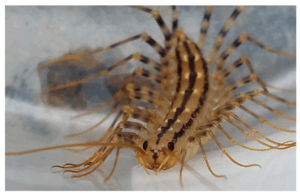
House Centipede
(Scutigera coleoptrata) Photo by Rob Irwin
This species is originally native to the Mediterranean, and has spread throughout North America, Europe and Asia. They belong to the group myriapods which includes all millipedes and centipedes. As you might have guessed from the name, they have a lot of legs! “Myria” relates to “many” and “pods” relates to “feet” (think podiatrist). Centipedes have one pair of legs per body segment, and tend to be faster than millipedes who have two pairs of legs per segment which get in the way of each other. These house centipedes are especially fast and can move up to 16 inches per second, which if they were the size of a human would be about 42 mph. Watching them scuttle you can see an entrancing wave pattern as their legs, which increase in length toward the back, cross over one another without colliding.

Photo by Robert Ransom
Their speed and a pair of jaws, which are actually modified legs, make them fearsome nocturnal predators of worms, snails, cockroaches, silverfish, and other small arthropods. They appear to have long antennae in the front and back of their bodies, which helps to confuse predators. The back pair of ‘antennae’ are another set of modified legs. Fine hairs on both of these structures detect scents, sounds and other sensory signals. House centipedes also have fairly complex eyes compared to other centipedes. In general these house centipedes are not aggressive toward humans, and will move away quickly if discovered. Their bite usually cannot pierce human skin, but can sometimes leave a bite similar to a honey bee sting. Next time you see one take a moment to admire how gracefully they run and if it is in your house you can always relocate it to a mulch or wood pile where it can hunt for cockroaches!