
Scientific name: Purshia stansburiana (Torr.) Henrard, formerly a variety of Purshia mexicana (D.Don) S.L.Welsh
Common names: Stansbury cliffrose, quininebush
Family: Rosaceae (rose)
Life form: Perennial flowering small tree or large shrub
Article by Jen Callaway
Purshia stansburiana, common name cliffrose, is an attractive, densely branched large shrub or small tree native to the southwestern United States (southeast California, northern Arizona, southern Utah and the northern half of Mexico). Its close cousin, P. mexicana, is a small tree native to western-northern Mexico, in the region of the Sierra Madre Occidental cordillera. Cliffrose is also called quininebush due to the bitter taste of its leaves.
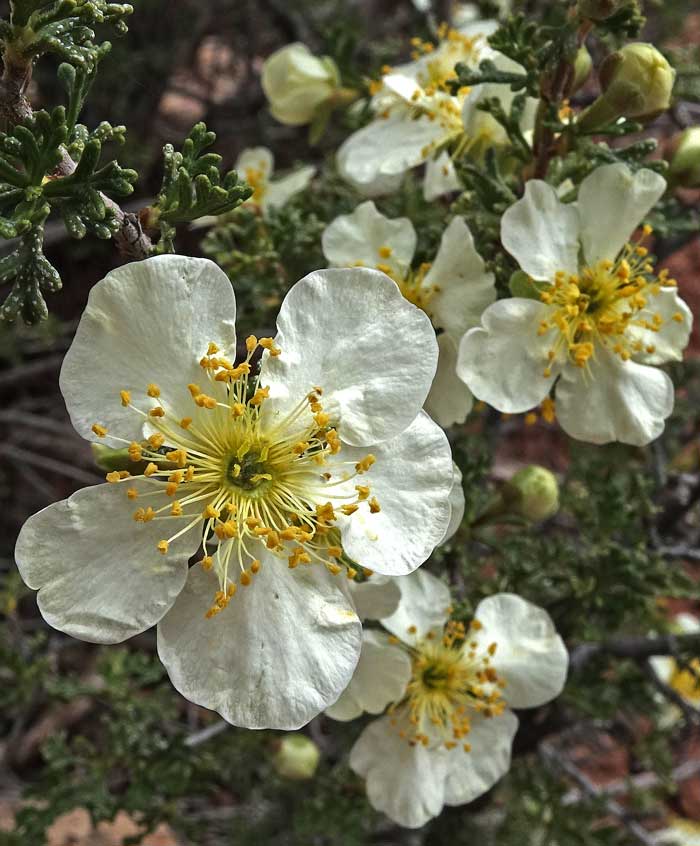
Purshia stansburyana. Photo ©Al Schneider, http://www.swcoloradowildflowers.com.
Cliffroses can be found in rocky spots in sagebrush plains, piñon-juniper woodlands, and semi-desert/desert habitats (1). Cliffroses prefer full sun and dry, rocky, granular soils, especially limestone or calciferous soils (2).
The cliffrose shrub is a rugged and long-lived species that typically grows up to 13 feet tall (and sometimes more), with attractive greyish-brown bark that gets a thin, peeling top layer as the shrub matures. In some remote locations such as the Grand Canyon, cliffroses even take on the form of a small sturdy tree 6 – 8 feet tall, with some even taller (up to 13 feet high) and with twisted 4”- 6” diameter trunks.
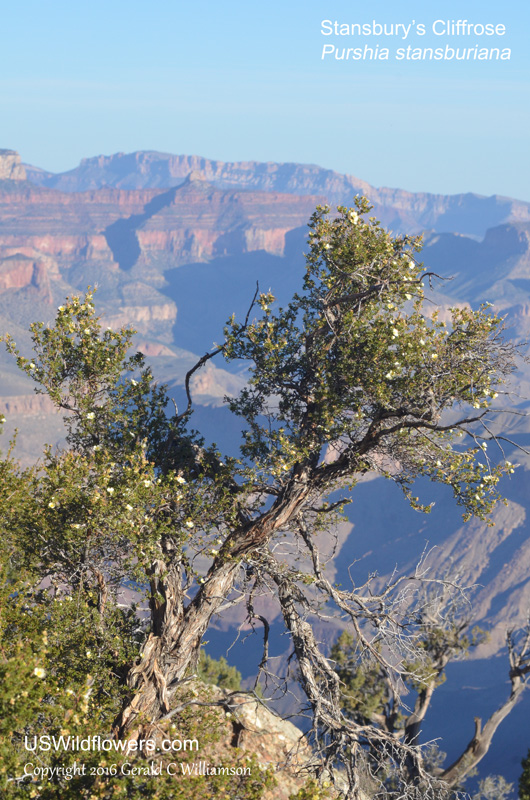
Grand Canyon National Park South Rim. Copyright: Gerald C. Williamson.
The creamy white flowers of the cliffrose have a distinctive rose-like appearance with a delightful fragrance that attracts pollinators of all kinds (1). The flowers are ½ to 1 inch in diameter with five rounded petals and 5 green sepals surrounding a center bushy cluster of numerous yellow stamens topped by yellow/orange anthers. The blossoms are followed by a plumed seed up to 2 ½ inches long and covered with many fine hairs somewhat like the seeds of the Apache plume shrub (Fallugia paradoxa, also in the rose family). This feature aids seed dispersal by the wind and helps the seeds drill themselves into the ground. The small leaves of the cliffrose are short, thick and glandular (sticky), bright green to gray green, and divided into 5 to 7 small lobes that have the appearance of little green mittens. A closely related species, P. tridentata, has smaller, yellow-petaled flowers and leaves with only 2-3 lobes.
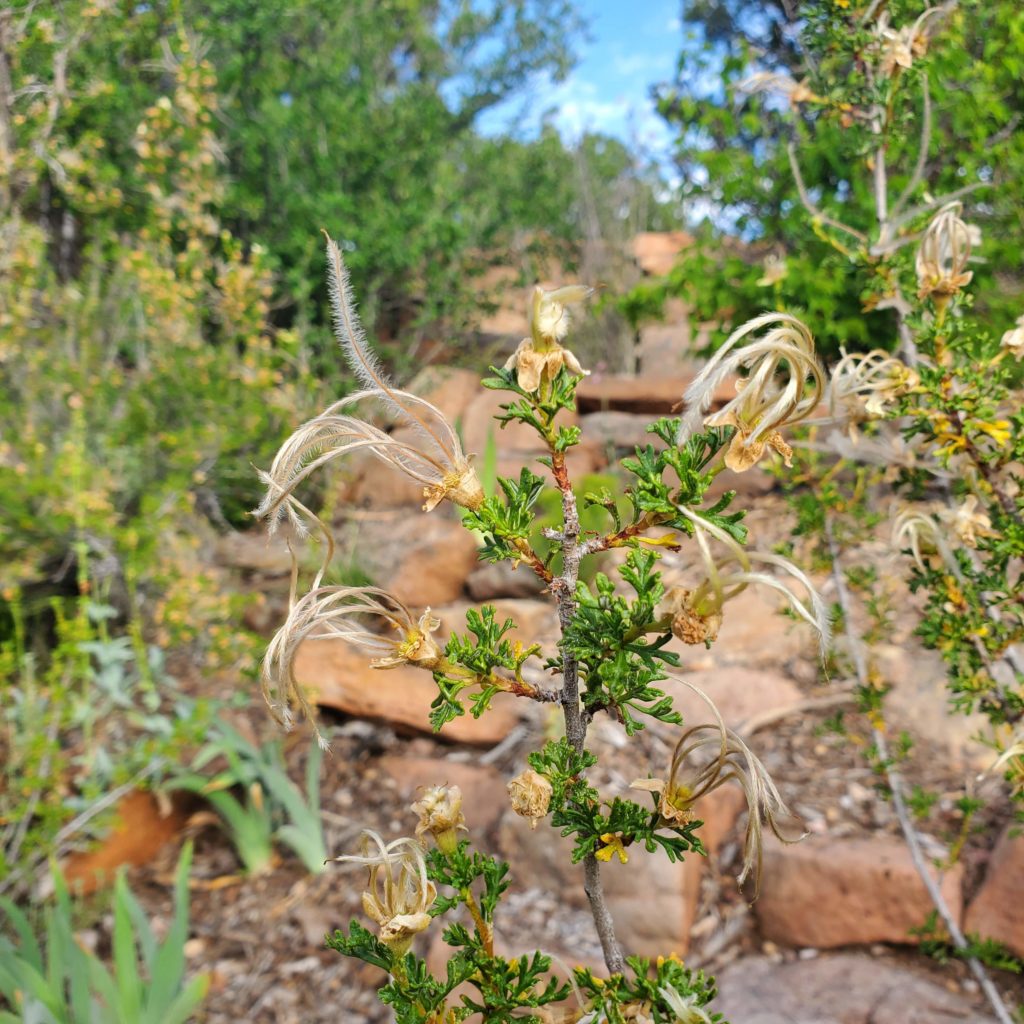
Cliffrose seed head. Photo: Linda Churchill.
Cliffroses have a long flowering season, with profuse and persistent blooms that often last from spring to the first frosts of fall and winter (1). This feature makes the cliffrose quite valuable for pollinators throughout its range. In midsummer, a cliffrose shrub may have flowers, semi-mature developing seeds and fully mature seeds on it all at the same time.
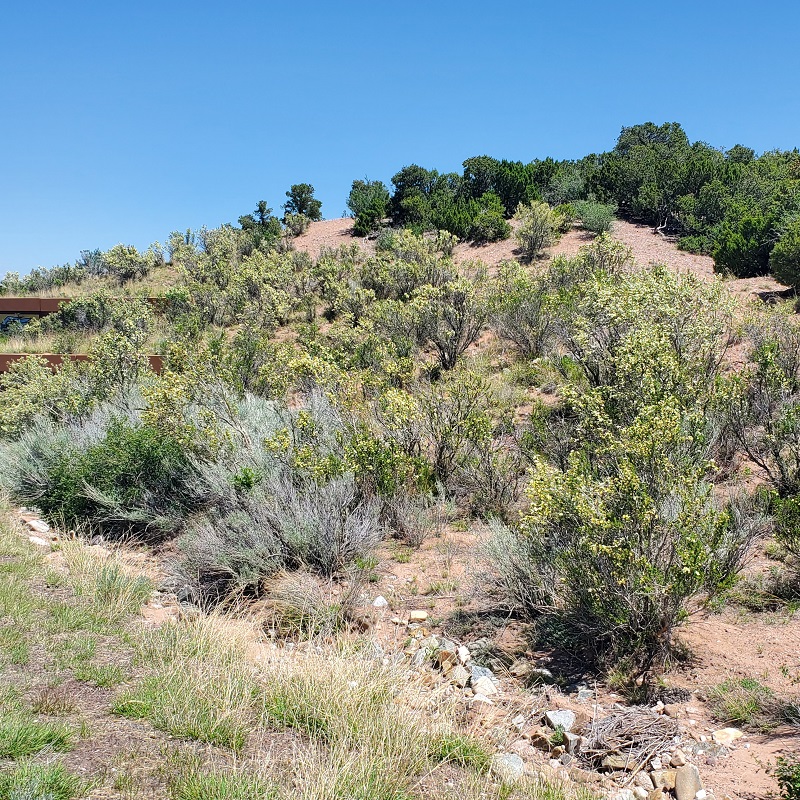
Cliffrose in landscape. Photo: Linda Churchill.
Native Americans traditionally used cliffrose bark and leaves for medicinal purposes as an emetic and for healing sores and wounds. The shredding bark of larger cliffroses was used to make cordage and to pad cradles. The dense, hard wood was carved into small tools, handles and for other crafts, while the thin straight branches were used for arrows (2).
The cliffrose is a vital component of the ecosystems in which it thrives (2). Its leaves provide forage for deer and desert bighorn, while birds and small animals eat the seeds and find shelter in its dense branches. Cliffroses aid in soil stabilization on steep slopes, and because they can reproduce vegetatively as well as by seed, they speed up revegetation after land clearing or other disturbances such as wildfires. After wildfires, cliffroses are often the first plants to repopulate burned areas (2). Cliffroses are not considered endangered, but the species’ distribution can be affected by habitat destruction from urban development and land use change (1), (2).
Cliffroses are a valuable addition to low water or xeric landscaping in Santa Fe and elsewhere, with their long bloom period of fragrant beautiful blossoms, their interesting seed heads, their curious-looking semi-evergreen leaves and the shrub’s upright shape. They tolerate harsh sunlight and drought as well as the cold, windy winters common in areas of higher elevations in the Southwest. The dense branch structure is self-maintaining with an occasional light pruning to remove dead branches in the interior of the shrub (1). As a landscape plant, cliffroses are generally resilient shrubs but can fall prey to aphids and spider mites. These problems generally can be managed by application of organic pesticides or by using natural controls (2). They can be prone to root rot if planted in soils that retain too much moisture (2). Regular monitoring and proper soil management will mitigate these risks.
P. stansburiana can be propagated by seed (4) but young shrubs are also commercially available at nurseries that specialize in plants of the Southwest. If propagating by seed, it’s important to protect sown seed from rodents like mice and pack rats. The first seeds on a mature shrub are usually of the highest quality, so these should be used by the home gardener. The seed heads can be collected by hand or with vacuum equipment; cold-moist stratification hastens germination.
In addition, semi-softwood cuttings may be taken from a healthy shrub in spring and late summer, then rooted in a pot using standard rooting techniques (e.g., dipping the end of a young shoot in rooting hormone powder, putting the cutting into moistened potting soil mixed 50-50 with lean, well-draining local soil, cover loosely with a plastic bag and put in bright indirect light until you see new growth). When planting a well-established seedling, a rooted cutting or a nursery-acquired specimen, be sure to plant your cliffrose in a full sun location in well-draining, lean soil (i.e., sandy clay-loam soil with low amounts of added organic matter). (4)
In the wild, local cliffroses can be found in and around Santa Fe on many of the rocky, sunny and steep areas that give them their common name. There are impressive native stands along the roadside cliffs of Hwy 285 north of Santa Fe near the Tesuque exit.
References
(1) Crossley, John. “Purshia stansburiana, Cliff Rose”. The American Southwest. 9 Oct 2025. Retrieved from: https://www.americansouthwest.net/plants/wildflowers/purshia-stansburiana.html
(2) “Stansbury’s Cliffrose (Purshia stansburyana)”. Botanical Realm. Web. 9 Oct 2025. Retrieved from: https://www.botanicalrealm.com/plant-identification/stansburys-cliffrose-purshia-stansburyana/
(3) “Cliffrose”. Canyon Dave Tours, Inc. Web. 9 Oct 2025. Retrieved from: https://www.grandcanyonnaturalhistory.com/pages_nature/trees_shrubs/cliffrose.html
(4) Native Plant Information Network, NPIN (2013). Published on the Internet https://www.wildflower.org/plants/result.php?id_plant=PUST [accessed October 27, 2025]. Lady Bird Johnson Wildflower Center at The University of Texas, Austin, TX.
(5) Howard, Janet L. 1995. Purshia stansburiana. In: Fire Effects Information System, [Online].
U.S. Department of Agriculture, Forest Service, Rocky Mountain Research Station,
Fire Sciences Laboratory (Producer). Available:
https://www.fs.usda.gov/database/feis/plants/shrub/pursta/all.html [2025, October 27].