
Scientific name: Marrubium vulgare L., Marrubium rotundifolium Boiss.
Common names: white horehound, mastranzo, silver edged horehound
Family: Lamiaceae (mint)
Life form: Herbaceous perennial
Range: Europe, North Africa, Canary Islands, Asia
Occurrence in New Mexico: Exotic
Article by Eva Maria Räpple
Horehounds are plants with broad, wrinkled, wooly, green leaves. Bees love its densely gathered small flowers which cluster in little bunches around its square stems. The flowers bloom from June to September, finally turning into burr-like seedpods, filled with miniscule seeds. These seed pods have tiny-tooth husks that entangle themselves in animal hair to the dismay of sheep and dog owners.
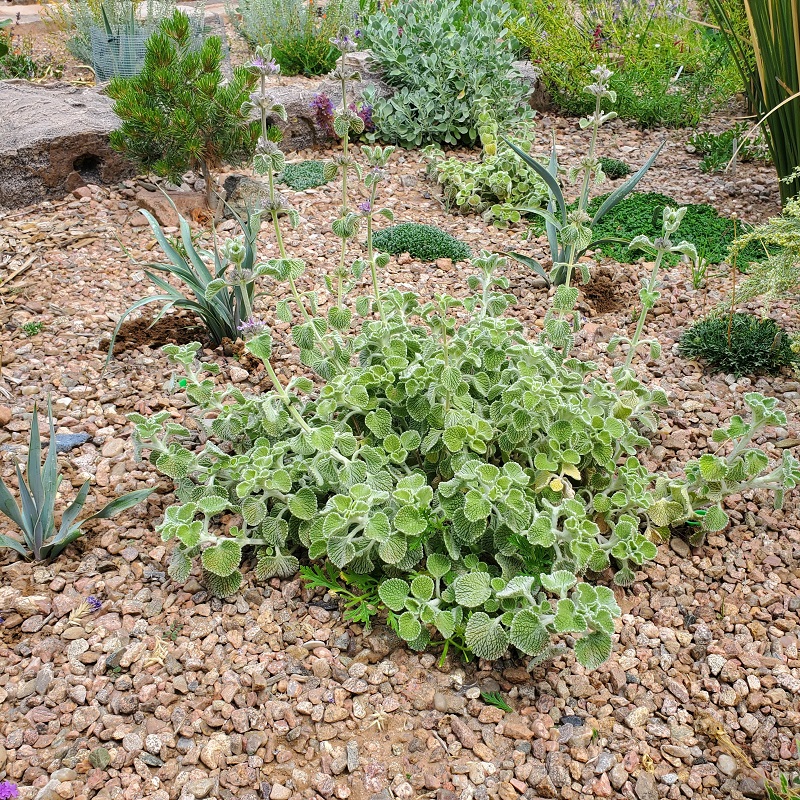
Marrubium rotundifolium, photo by Linda Churchill.
The most widespread species of Marrubium, M. vulgare, originated around the Mediterranean Sea and western Asia but is today widespread throughout the world including North and South America. Horehound, a member of the mint family (Lamiaceae), is easy to grow, tolerates poor, sandy soils. It does not like wet conditions and can be found in abandoned lots, along arroyos, and areas of compacted soils in elevations from sea level to 7,500 feet. It can be propagated through seeds, cuttings, and division. Since most animals dislike its intensely aromatic bitter taste, horehound, like other mints, spreads effortlessly, and can become invasive often forming mounds that are 3-4 feet in circumference that can grow up to two feet tall.
Marrubium rotundifolium, silver edged or silverheels horehound, offers a beautiful, xeric groundcover, tolerant of poor soil areas, and can be a great addition to the dry Santa Fe gardens. Marrubium rotundifolium is from Turkey and is not known to have naturalized elsewhere in the world. This bee friendly, deer and rabbit resistant plant has felted lime-green foliage with a silver underside, well suited to grow in hot, sunny growing conditions. For the home gardener, even growing horehound in pots is an option.
Most people know white horehound, Marrubium vulgare, for its medical properties. If used with the addition of sugar, mint, vanilla, and lemon, it is famous as hard candy or cough drops. Ricola, the Swiss cough drops, lists horehound as an important ingredient. In the US, a cocktail known as “Rock and Rye” includes either an infusion of the bitter herb or dissolved Horehound candy.
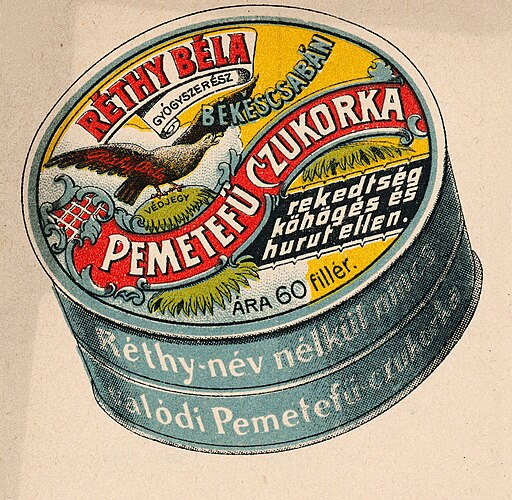
Advertisement – Horehound candy box by Rethy Béla (Hungary, 1907). Uploaded by Takkk. Wikimedia Commons. Licensed under CC BY-SA 4.0.
Horehound’s medicinal properties have a long history. The plant has been used as medicine since antiquity. The Roman Pliny the Elder, in his encyclopedic work The Natural History (77 CE) describes Marrubium as “a plant of the very greatest utility”. Among its numerous applications, it is specifically useful for afflictions of the chest, also for digestive issues, and support for women after birth. It can be powdered, cooked as a tea, and is frequently used with honey to mitigate its extreme bitterness.[i]
Throughout medieval Europe, Marrubium regularly appears in herb gardens. It e.g. is mentioned in the garden plan of the abbey of St. Gall (Switzerland), and the abbey at Reichenau (Germany). Written sources from the time of Charlemagne (around 800 CE), comment on white horehound, praising its outstanding healing properties. It also appears in the Hortulus de cultura hortorum, a poem written by the monk Wahlafrid ‘Strabo’. The text refers to rather surprising uses such as an antidote to poisonous plants that one might have swallowed.[ii] Today, horehound’s fame as a medicinal plant is supported by analyses of the plant’s high bioactive potential. Numerous studies have shown that Marrubium vulgare contains a complex combination of phenol and flavonoid compounds, which provide antioxidant and anti-inflammatory agents.[iii]
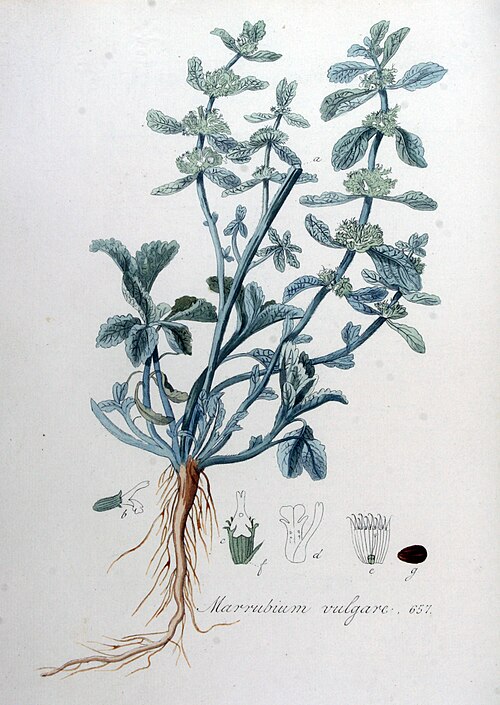
Marrubium vulgare — Flora Batava — Volume v9. Wikimedia Commons. Public domain.
Marrubium vulgare has also been studied as an option for phytoremediation (technology to use plants for cleanup of contaminated soils, water, and air) of toxic mercury (Hg) in a mining district in Spain. White horehound, with its great adaptability to all kinds of soils and growing conditions, has proven to be good candidate for Hg phytoremediation of contaminated soils.[iv]
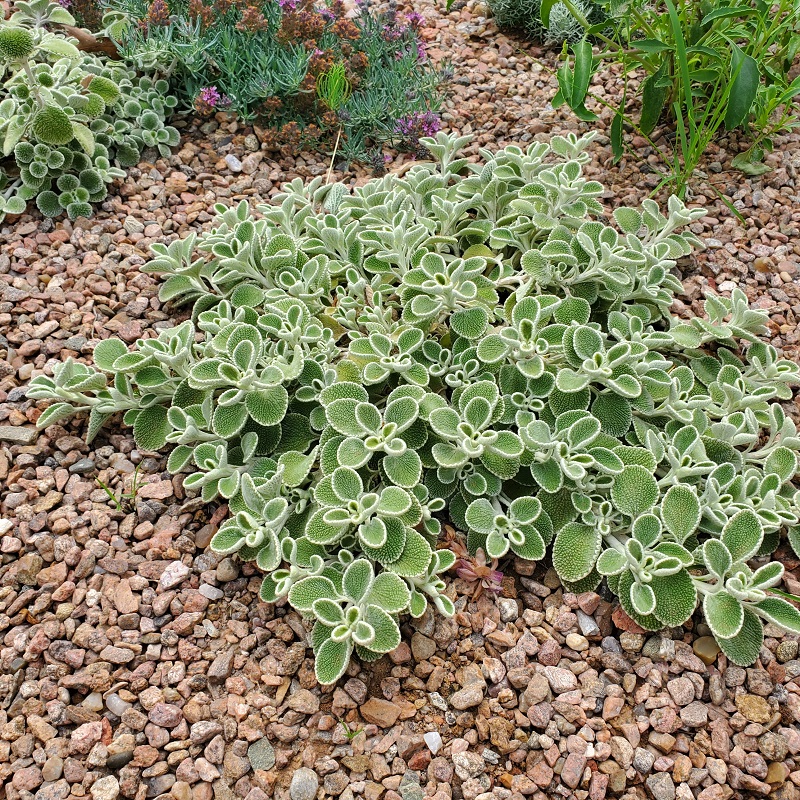
Marrubium cylleneum, photo by Linda Churchill.
The humble horehound is not one of the garden blockbusters, but the plant warrants renewed attention for its many services. The purple flowering Marrubium cylleneum or the silverheels horehound (M. rotundifolium) insert textured colorful accents to xeric gardens, attracting birds and pollinators. Adding Marrubium vulgare to the herb section could also offer welcome relief when, colds, coughs, and intestinal troubles strike, but beware of its aggressive tendancies. Just a little honey will be needed to sweeten its strong bitterness.
References
[i] Plin. Nat. 20.89. Pliny the Elder, The Natural History
John Bostock, M.D., F.R.S., H.T. Riley, Esq., B.A., Ed. Perseus Project. Retrieved from: https://perseus.tufts.edu
[ii] Chavannes-Mazel, Claudine A., and Gerda van Uffelen. “Naming Names: Plants in the Age of Charlemagne.’ The Green Middle Ages: The Depiction and Use of Plants in the Western World 600-1600, edited by Claudine A. Chavannes-Mazel and Linda IJpelaar, Amsterdam University Press, 2022, pp. 129–43. JSTOR. Retrieved from: https://doi.org/10.2307/jj.1231865.9.
[iii] Mahdi Aeineh et al. “Evaluation of pharmaceutical compounds at vegetative and reproductive growth stages of Marrubium vulgare a medicinal plant to cleanse the body” Natural Product Research. 2024, Vol. 38, NO. 19, 3433–3437. Retrieved from: https://doi.org/10.1080/14786419.2023.2245116
[iv] E. Moreno-Jimerez et al. Mercury bioaccumulation and phytotoxicity in two wild plant species of Almaden area Chemosphere 63 (2006) 1969–1973. Retrieved from: https://www.sciencedirect.com/journal/chemosphere