
July 2025
By Ben Ouaou
2025 Jill and Stanley Jankowski Science and Conservation Intern
June 13th’s long-anticipated restoration workshop at the Santa Fe Botanical Garden’s Piñon-Juniper Woodland, led by Jan-Willem Jansens of Ecotone, was successful in several ways, teaching local participants new ways to care for their surrounding ecosystem while building tools for the Garden to manage their own showcase of a native New Mexican environment. An overview of the project can be found here. A survey sent to the participants also gauged their opinions on the workshop’s effectiveness. Most respondents believe that it succeeded in presenting the restoration process and helping participants understand the complexity of the ecosystem. There is unanimous agreement that the workshop was highly successful in teaching restoration techniques, processes, and materials, and that it will reduce erosion and improve soil health. One factor would remain to be seen upon the workshop’s completion, however: how well these new rock dams and drainage catchments would stand up to Santa Fe’s regular summer monsoons throughout the coming weeks.
The month since the workshop has been scattered with summer precipitation, bringing about 1.59” of rainfall to Santa Fe (weather underground) during a crucial period determining how well the constructions of the workshop will stand against future time and weather to build healthier soil in the Woodland. Even just 12 days after the completion of the workshop, it was clear that the erosion control structures were doing their job to prevent excessive runoff and channeling after a June 24 monsoon, but seed-growth progress was to be determined.
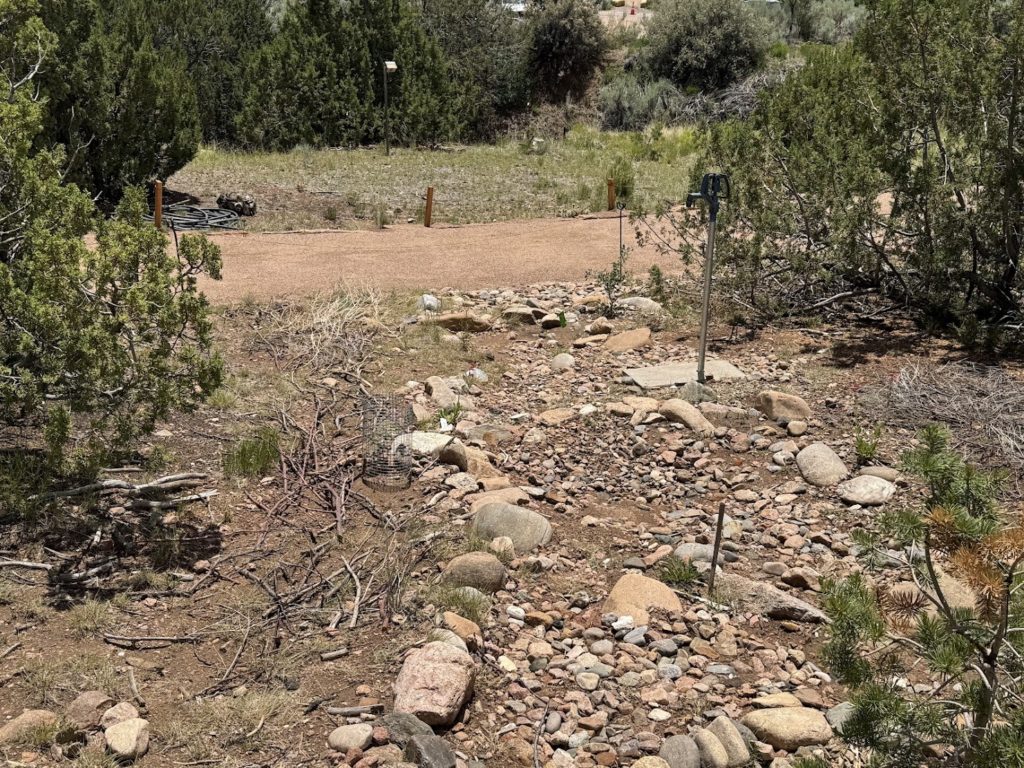
Rock dams and mulch working to prevent excessive runoff onto the trail below on June 25. Photo by Ben Ouaou.
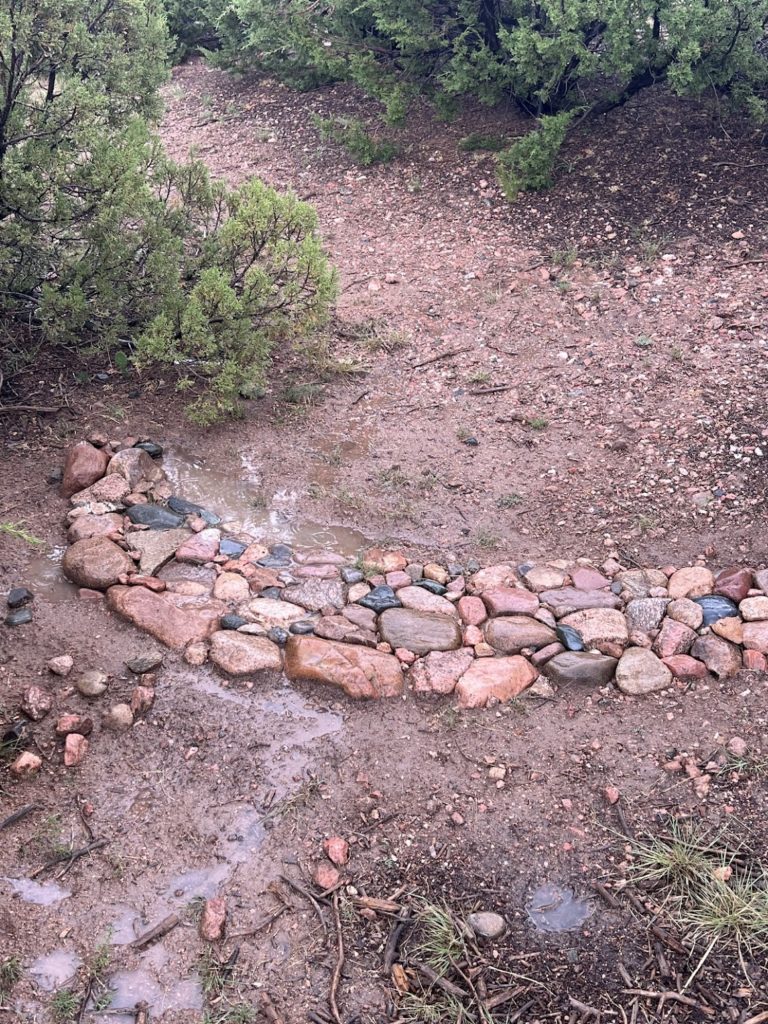
A rock dam working to catch and spread water after heavy rain on July 1. Photo by Noah Gapsis.
After several weeks, it is clear that most of the sites built during the workshop have helped to control water erosion in the Woodland. Meanwhile, new structures have been built that expand on the workshop’s efforts. With the help of volunteers on one occasion, six more rock dams have been carefully placed in and around the original sites to bolster soil protection and opportunity for grass growth. A smaller rock dam was built adjacent to the media luna, for instance. Near the northernmost site, it became obvious that mulch was washed off the area onto and beyond the trail below, so more rocks were used to line the top of the trail.
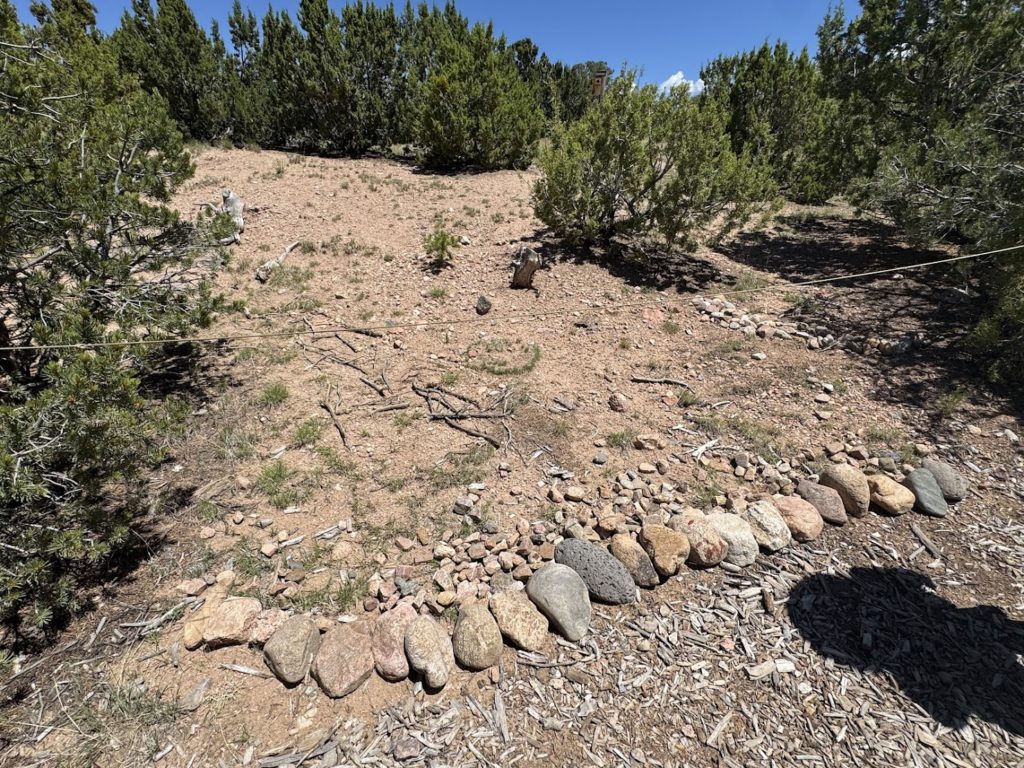
One of the new additions: a line of rocks preventing runoff and mulch displacement. Photo by Ben Ouaou.
Seeding also continued after the workshop. Large sticks placed throughout the Piñon-Juniper Woodland represent newly planted Eriogonum jamesii (James’ buckwheat), a native plant that does not need much watering and is great for pollinators. About thirty buckwheats were planted at a new site closest to the Woodland’s entrance. Three more native oak trees were also planted in the Woodland.
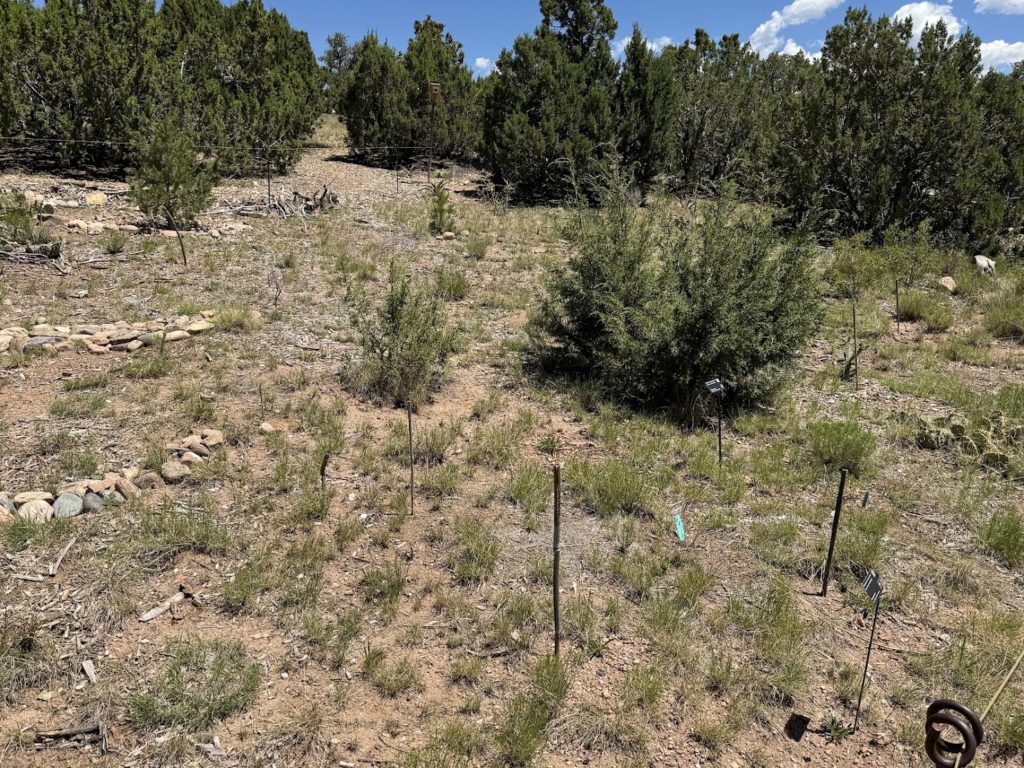
Stakes marking recently planted buckwheat near other new construction. Photo by Ben Ouaou.
Of the grasses seeded during the workshop itself, many are beginning to sprout and become visible. This is particularly evident at the main site of lop and scatter where Jan-Willem first demonstrated to participants how to properly rake and seed grasses that will grow into and help improve the soil. Here, and at other sites to a lesser degree, grass patches are emerging from beneath the mulch and dead tree branches to cover the previously exposed, sandy soil.
Grasses used in seeding, from Plants of the Southwest native dryland blend (click on name to learn more in the Garden Explorer plant database):
- Bouteloua gracilis (blue grama)
- Bouteloua curtipendula (sideoats grama)
- Eriocoma hymenoides (indian ricegrass)
- Elymus trachycaulus (slender wheatgrass)
- Hilaria jamesii (galleta)
- Sporobolus airoides (alkali sacaton)
- Festuca ovina (sheep fescue)
- Schizachyrium scoparium (little bluestem)

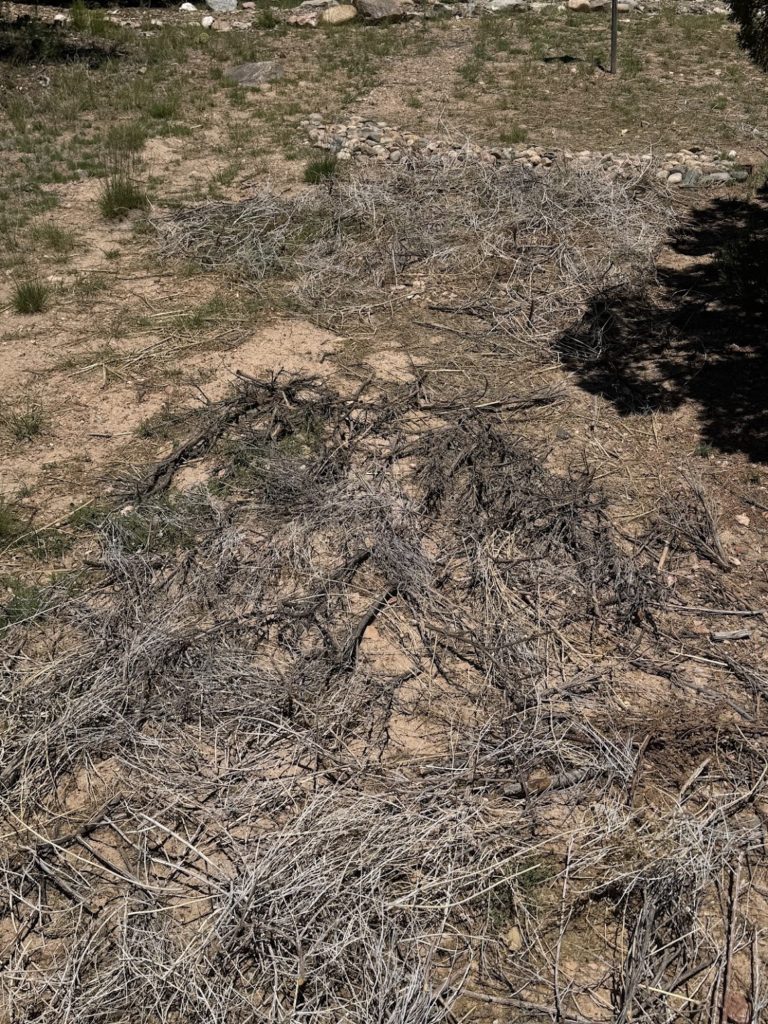
The difference between one seeded area from the June 13 workshop (top) to July 8 (bottom). Grasses have quickly grown to cover the once exposed soil. Photos by Joanna Ruppel and Ben Ouaou.
After about one month, those involved with the Garden’s workshop are beginning to notice its restorative effect on the Piñon-Juniper Woodland. Seeds are sprouting, erosion and channeling are less apparent, and new structures continue to be built to expand on this change. Some participants are even finding personal use out of the workshop’s results: “I have attempted to sow native grass seeds on my property using the technique I learned. I also have constructed a couple mini [media lunas] and one rock dams in key areas” – anonymous survey respondent. Another anonymous participant was surprised to learn how structures can be built to “disappear” and look natural in the surrounding environment, and has since used their knowledge to conduct similar work in locations like Galisteo Basin.
The more restoration work that is done, the more that presents itself as available to do, a positive chain reaction that continues to ripple through the Garden’s Woodland as these projects are monitored and expanded.
Additional restoration resources: