
Scientific name: Ailanthus altissima (Mill.) Swingle
Common names: tree of heaven
Family: Simaroubaceae
Life form: Perennial flowering small tree or large shrub
Bloom time: Early summer with clusters of small yellow flowers appearing on a 20-inch-long stem
Fruit: Tan to reddish, single winged, that can remain on the female plant through winter. A single mature tree can produce over 300,000 seeds per year.
Distribution: Native to northeastern and central China and Taiwan, it was introduced to the United States in 1784 as an ornamental plant and is growing in all 48 continental states.
Article by Cheryl Fossum Graham
Background
Though its name makes it sound divine,
the invasive tree of heaven is no angel.
– The Nature Conservancy
The tree of heaven was introduced into the United States in the late 1700s as an ornamental tree. In the years since its introduction, it has become a focus of Extension Services in nearly every state where its invasion has created havoc with regular crop production, landscaped areas, sidewalks, highways, and building foundations. In short, it seems to thrive in any disturbed soil regardless of location or climate. In New Mexico, the “not so heavenly” tree has been especially problematic as it crowds out native species and has resisted eradication attempts.
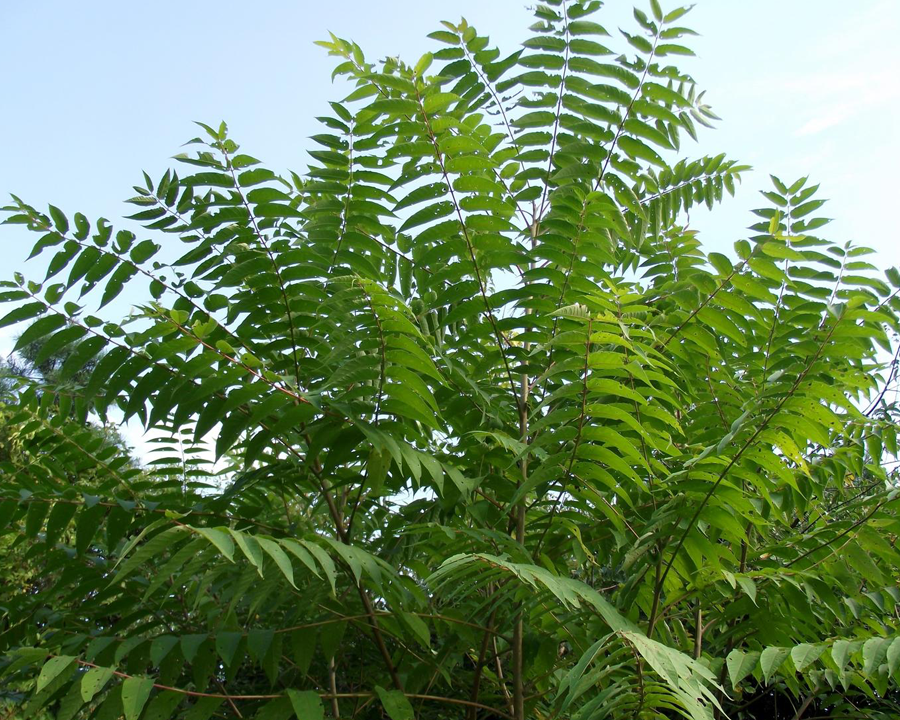
Tree-of-heaven (Ailanthus altissima). Photo: Richard Gardner, Bugwood.org (Accessed 14Dec 2025 from https://extension.umd.edu/resource/tree-heaven/).
Ecology
The tree of heaven (Ailanthas altissima) is a major invasive species that is found in every state in the continental United States. Since its introduction as an ornamental tree in 1784 it has become an agricultural invader in part because of its ability to grow under almost any soil or climatic conditions. While its seeds are an important means of widespread distribution, once it has established itself in the soil, it sends out tuberous roots that survive from year to year and resist efforts to extract them from the ground or kill them with herbicides. Its opportunistic behavior has been especially troublesome for any disturbed soil along roads, sidewalks and building foundations, where the tuberous root system works its way into cracks and crevices and can destroy the overlying roadbed, sidewalk, sewers or building foundation.
Characteristics
One of the defining characteristics of the tree of heaven is its odor which is often described as smelling like rancid/ burnt peanut butter or cat urine. The chemical ailanthone that produces this odor is located in all parts of the plant and is responsible for inhibiting the growth (allelopathy) of other plants leading to large clumps of the tree of heaven spreading into cultivated fields and pushing out crops, native trees and grasses.
The ailanthone makes all parts of the tree mildly toxic to humans (causing headaches/nausea if ingested) and the sap irritates skin/eyes, while the pollen causes allergies. If working to pull or cut down the tree of heaven, it is recommended that you wear protective clothing and avoid touching your eyes or other sensitive skin until all sources of the chemical have been removed.
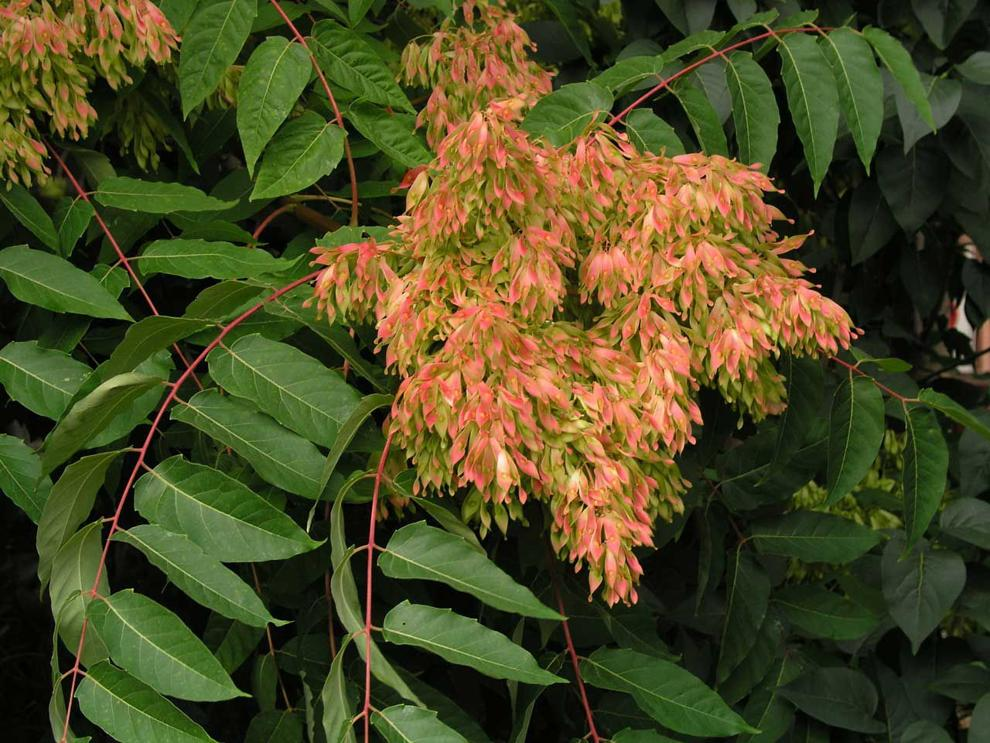
Leaves and Seeds of Tree of Heaven; Sarah Baldwin Santa Fe New Mexican August 2, 2018.
While many communities around the country have worked diligently to eradicate the tree of heaven, the relationship with this tree in Santa Fe is much more nuanced. Sarah Baldwin of the Santa Fe New Mexican investigated that relationship in an article she wrote in 2018 (Tree of Heaven or Hell?). She writes:
Ailanthus‘ tolerance of extremely poor soils and total neglect has earned it the nickname “ghetto tree” in places like Detroit, where it’s often the only thing flourishing in the ravaged urban landscape. Depending on the situation, that toughness can be a virtue. In Betty Smith’s classic novel A Tree Grows in Brooklyn, a tenacious tree of heaven growing in concrete serves as the central metaphor for survival in adverse circumstances.
I have an ambivalent relationship with the tree of heaven on our property. On the one hand, it requires no irrigation and shades our west-facing driveway, keeping our cars cooler in summer. It also adds carefree greenery to the street scene. On the other hand, it sends shoots far and wide, through juniper bushes and under other trees. If I didn’t stay on top of pulling these shoots, we’d soon be in a tree-of-heaven jungle.
Do you have a tree of heaven growing on your property? Is it welcome or unwelcome? There are no specimens of the tree of heaven growing in the Santa Fe Botanical Garden, but it can be found growing along the roadways and alleys all around Santa Fe. There is a jungle of tree of heaven growing along both sides of the alley in the back of my house which the City mows down about once a year and they immediately grow back, increasing their territory every year.
Works Cited
Integrated Taxonomic Information System. Ailanthus altissima. ITIS, www.itis.gov/servlet/SingleRpt/SingleRpt?search_topic=TSN&search_value=28737
. Accessed 14 Dec. 2025.
“Invasive Species: Tree-of-Heaven (Ailanthus altissima).” EDDMapS – Early Detection & Distribution Mapping System, www.eddmaps.org/species/subject.cfm?sub=3003
. Accessed 14 Dec. 2025.
“The Journey with Nature: Tree-of-Heaven.” The Nature Conservancy, www.nature.org/en-us/about-us/where-we-work/united-states/indiana/stories-in-indiana/journey-with-nature–tree-of-heaven/
. Accessed 14 Dec. 2025.
“Tree of Heaven or Hell?” Santa Fe New Mexican, www.santafenewmexican.com/life/home/tree-of-heaven-or-hell/article_c3d5a94e-7886-555d-904f-65a5265ffb5c.html
. Accessed 14 Dec. 2025.
“Tree-of-Heaven.” Penn State Extension, Pennsylvania State University, extension.psu.edu/tree-of-heaven. Accessed 14 Dec. 2025.
Winston, R. L., et al. Field Guide for the Biological Control of Weeds in Eastern North America. USDA Forest Service, Forest Health Technology Enterprise Team, 2017, Morgantown, WV. FHTET-2016-04, bugwoodcloud.org/resource/pdf/FHTET-2016-04_Biocontrol_Field_Guide.pdf.