
Western Black Widow (Latrodectus Hesperus)
Blog by Rosy Link, Program Coordinator
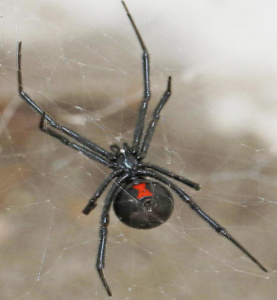
The western black widow spider, Latrodectus hesperus, can be found throughout New Mexico from February through November. There are five species of spiders in the same genus, Latrodectus, which roughly translates to ‘secret bitter.’ “Latro” is derived from Latin and means robber or brigand and “dectus” from Ancient Greek δήκτης (dēktēs) means bitter. You might spot these iconic spiders tucked into dark undisturbed spaces like the underside of rocks or leaves, pipes, and the corners of garages and sheds.
Description:
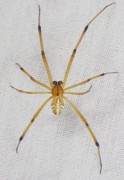
Adult female spiders are about half an inch long, 12 -14 mm, with a plump, black, shiny abdomen with the characteristic red hourglass shape on the underside. Adult males are smaller, about 7-8 mm and are light brown with three pale stripes on each side of the abdomen. They also have an hourglass but it is usually yellow or orange. The initially tiny spiderlings resemble the males, light brown with pale stripes and a yellow/orange hourglass.
Habitat and Behaviors:
Tending to nest in small dark spaces, females weave irregular webs to catch prey including flies, cockroaches, grasshoppers and other insects. They kill their catch by injecting venom through two hollow fangs and bite the body multiple times to feed on the liquid contents inside, leaving behind a husk of exoskeleton.
Life Cycle:
Females can live up to a year and a half, while males only live about a month or two. You can sometimes see male widows perched in the webs of females, hoping to snag some food. They mate during summer and can lay between 4 – 9 egg sacs in a season. Egg sacs are round, white or tan and about 1 cm in diameter, typically nestled into the web with the female spider nearby. The eggs develop in about 14 days and the cannibalistic young fight amongst themselves within the egg sac, leaving only a few to survive and grow into adults. The spiderlings remain near the web at first and eventually climb to a high point, spin a balloon of silk and drift on the wind to a new spot to build their web. This time of year the females and immatures are overwintering in warm places like sheds or houses, but as temperatures warm up they may begin to emerge.
Are They Dangerous?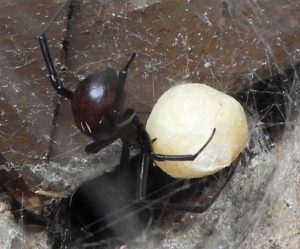 Although these are the most venomous spiders we have in North America, death from a bite is unlikely. However, if anyone is bitten by a black widow spider, they should seek prompt medical treatment because it is very unpleasant. The severity of the reaction can vary from case to case, and are worse for young or elderly people. Symptoms include redness at the injection site, abdominal cramping, sweating, and nausea that can last up to 48 hours. If you are bitten by a black widow, you should get treatment as soon as possible to reduce the symptoms and avoid any complications.
Precautions to Stay Safe:
People are usually bitten by females near their egg sacs, so keep an eye out when turning over rocks or equipment that have laid untouched for a while. It’s always a good idea to wear gloves when working outside, and to be aware of your surroundings. Educate your families and friends about how to recognize these spiders. In general, if they are in a space unlikely to come into contact with humans, they are a beneficial invertebrate to have in your yard or garden, contributing to the food chain and potentially helping to control pests.
Sources:
https://agsci.colostate.edu/agbio/ipm-pests/32655-2/
https://bugguide.net/node/view/26346
Photo top left: Adult female Photo Credit: Bill Maynard
Photo middle: Adult male Photo Credit: Chris Kotzer
Photo bottom right: Adult female with egg sac Photo Credit: Jim Eckert