
Red Shouldered Bug (Jadera haematoloma)
Blog by Rosy Link, Program Coordinator
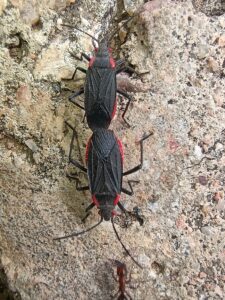
mating red shouldered bugs
Walking around my neighborhood I have recently seen a lot of small black and red insects crawling on the sidewalk. I photographed a group all gathered around a juniper seed. I also often see them mating, where they walk around with their backends stuck together with one walking backwards!
These are called red shouldered bugs, Jadera haematoloma, also called scentless plant bugs, jadera bugs and golden rain tree bugs. They are in the order of the true bugs, Hemiptera. All of the insects in this group share similar traits like a long sucking mouthpart and a characteristic “X” shape formed by the wings. The name Hemiptera means “half-wing” where the upper portion is solid and the bottom membranous.
While some are carnivorous, this species feeds on plants using their long rostrum or beak to poke into the tissue usually of fruits or seeds so they can reach the liquids inside. You can often see them basking on warm sidewalks, walls, or tree trunks in large groups and near their host plant. Adults and young feed on sap from seeds, flowers, leaves, and fruits of trees including stone fruits, box elder, apples, chinaberry, western soapberry, ash, maple, and golden raintree.
Life Cycle and Description:
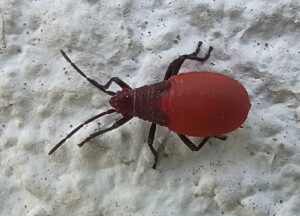
nymph
Adult females overwinter and emerge in spring to lay eggs in tree bark. The young nymphs take about 40 days to mature. There can be 2 or more generations per year. You will often see all ages and sizes mixed together in a group. Adults have flat bodies about 1/3 to 1/2 in or about 9-13mm long that are black/blue/brown with bright red markings around the eyes, shoulders, and edges of the abdomen with three vertical red lines behind the eyes.
Their name haematoloma means “blood-fringed” referring to these markings. Adults have variation in the length of the wings, so you might see some with full wings, (called macropterous, “large-winged,”) and others with slightly reduced wings (called brachypterous, “short-winged.”) While the full winged individuals are able to fly to help the population reach new areas, the short-winged individuals lack flight muscles. The small nymphs are mostly red with a brown thorax (midsection,) antennae, rostrum, and legs. As they grow, they gradually turn black with red markings and wings will develop from small pads on their back.
Interaction with humans:
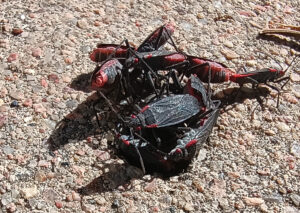
red shouldered bugs gathered around juniper seed
They are harmless and do not bite or produce any foul smells. You may see discoloration on young fruits if red shouldered bugs have been feeding on them, but they tend not to cause much damage. They often eat seeds and fruits that have fallen to the ground. I even saw them surrounding a piece of bread that had fallen on the street. In the winter you might find both adults and nymphs in your home or garage as they look for somewhere warm to shelter. Outside they will look for natural or human made crevices during cold weather. If they come into conflict with your space you can sweep up the fallen plant material and move it to a better location where you won’t mind the bugs.
Maybe you will see congregations of red shouldered bugs in your garden and yard this spring!
Sources:
https://www.bugguide.net/node/view/3601
https://www.biorxiv.org/content/10.1101/2025.01.17.633577v1.full